
AIOT Modular Architecture Description
Event-Driven Smart Port Management Architecture
From “seeing the footage”
to “understanding risk, efficiency, and decision insights”
Our AIOT Smart Port solution is built around an event-driven design philosophy.
It transforms information that is traditionally scattered across video feeds, equipment, sensors, and operational workflows into traceable, reviewable, and analyzable management events.
The goal is not to replace on-site personnel, but to enable managers to identify issues earlier, understand situations more clearly, and make decisions based on solid evidence rather than assumptions.
AI Vision Safety & Behavior Recognition Module
Positioning Description
This module serves as the first intelligent foundation for port safety management. Its core purpose is not to replace on-site personnel, but to assist management units in identifying potential safety risks within the port area in real time. Through image-assisted recognition, managers can immediately understand where issues may arise, rather than conducting investigations only after incidents occur.
❖ Management Value
– Shifts safety management from post-incident review to proactive alerts
– Reduces occupational accidents and injury risks
– Does not alter existing operational procedures; on-site operations remain human-led
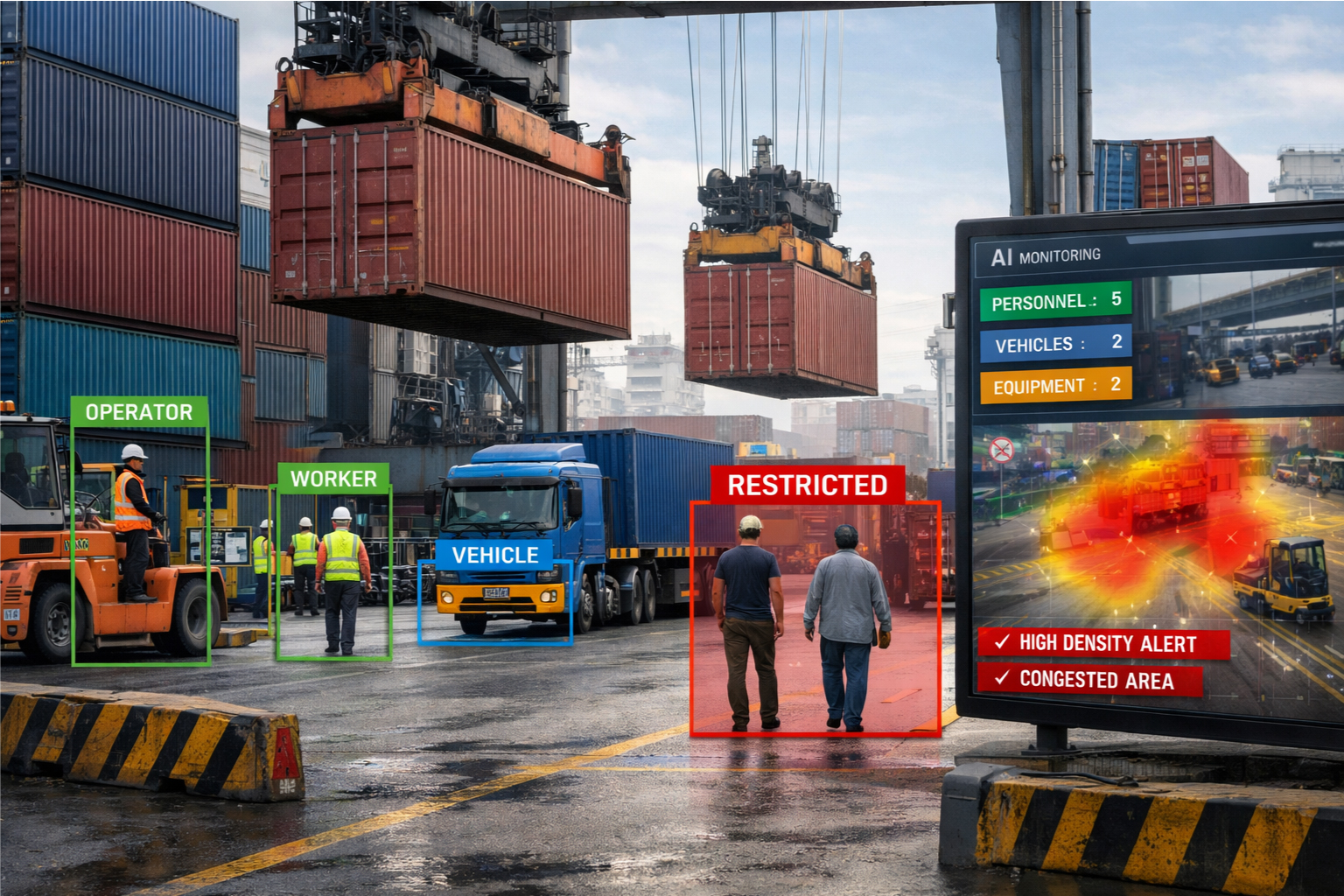
Real-Time Recognition of Personnel, Vehicles, and Equipment
Scenario | Lifting Operation Zone
During container lifting operations, regulations require that non-operational personnel be restricted from entering the designated lifting zone.
Traditional Situation
Management units rely primarily on manual monitoring of surveillance screens, making it difficult to immediately identify areas with high levels of mixed traffic.
After Implementation
The system can instantly distinguish between personnel, vehicles, and equipment, clearly displaying areas with high density and routes with abnormal traffic concentration on the management interface.
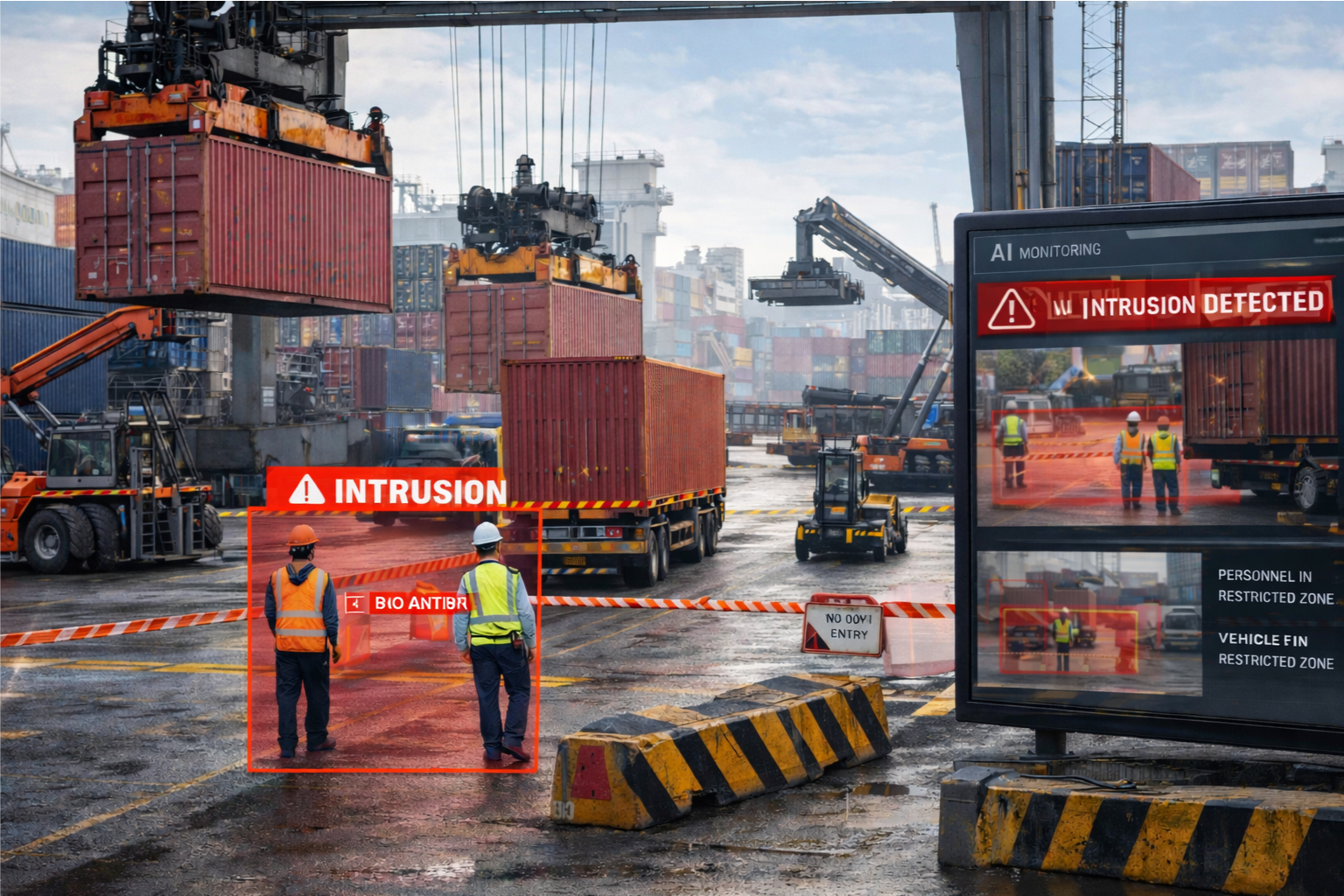
Hazardous Zone Intrusion Detection
Scenario | Peak Cargo Handling Period
During peak cargo handling periods, dock operations involve pedestrian workers, container trucks moving in and out, and continuously operating cranes and forklifts, creating a highly complex operational environment.
After Implementation
If personnel or vehicles enter a restricted zone, the system immediately flags the event on the management dashboard, enabling prompt response by management staff.
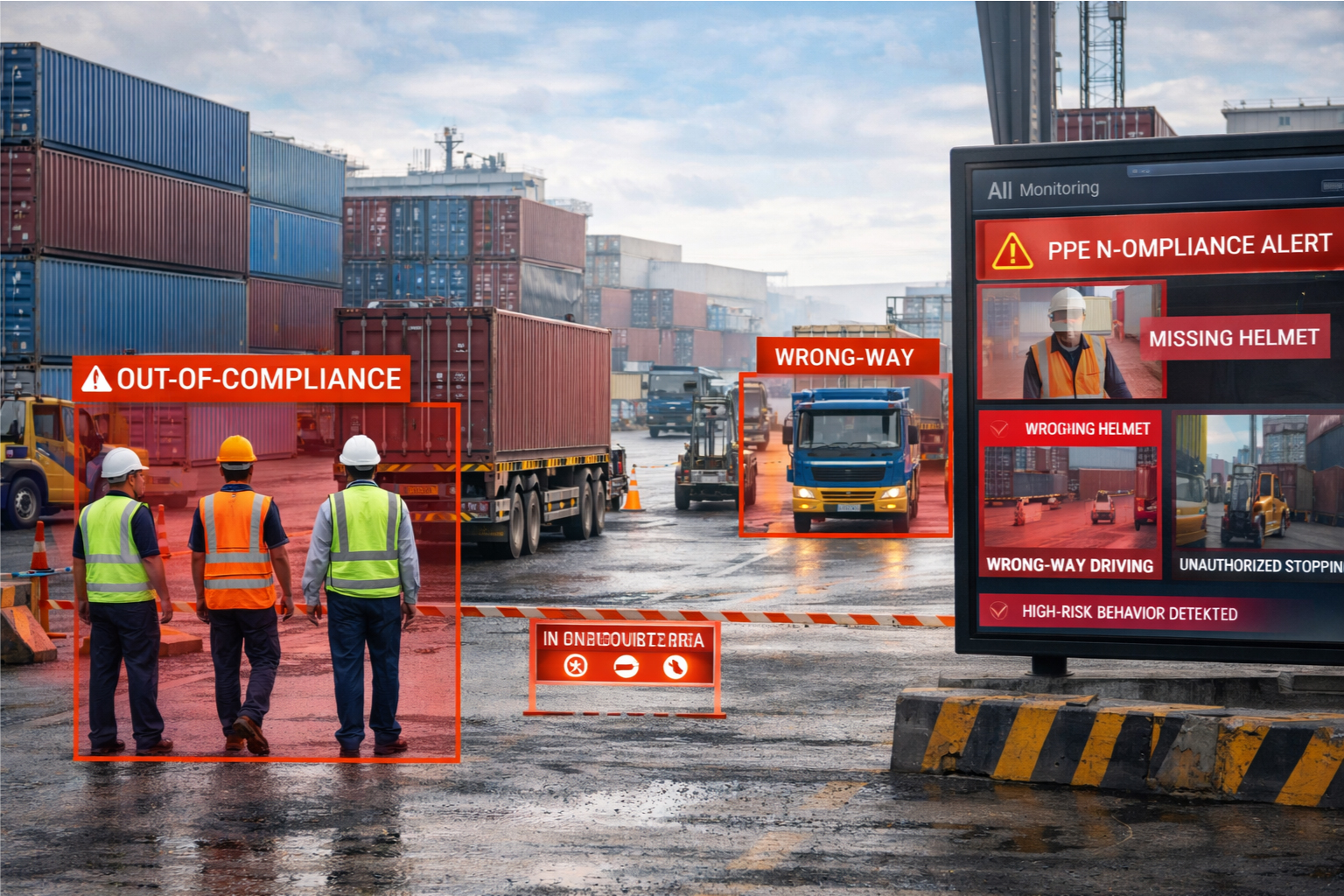
PPE (Helmet and Protective Equipment) Compliance Check
The system identifies whether personnel are properly wearing helmets and protective equipment in high-risk areas, recording non-compliance as events for management follow-up and reminders.
Abnormal Behavior Detection (Wrong-Way Driving, Prolonged Stopping, Mixed Traffic)
The system flags high-risk behaviors such as wrong-way driving, prolonged stopping in unauthorized areas, and mixed pedestrian–vehicle traffic, supporting traffic flow optimization and safety management.
Operational Node Eventization Module (Gate / Yard / Berth)
Positioning Description
The core purpose of this module is to transform daily port operational processes “previously fragmented and difficult to trace” into event-based records that can be documented, queried, and analyzed. Through eventization , management units can clearly understand how containers, vehicles, and workflows actually operate within the port, rather than relying solely on experience or ad-hoc reports.
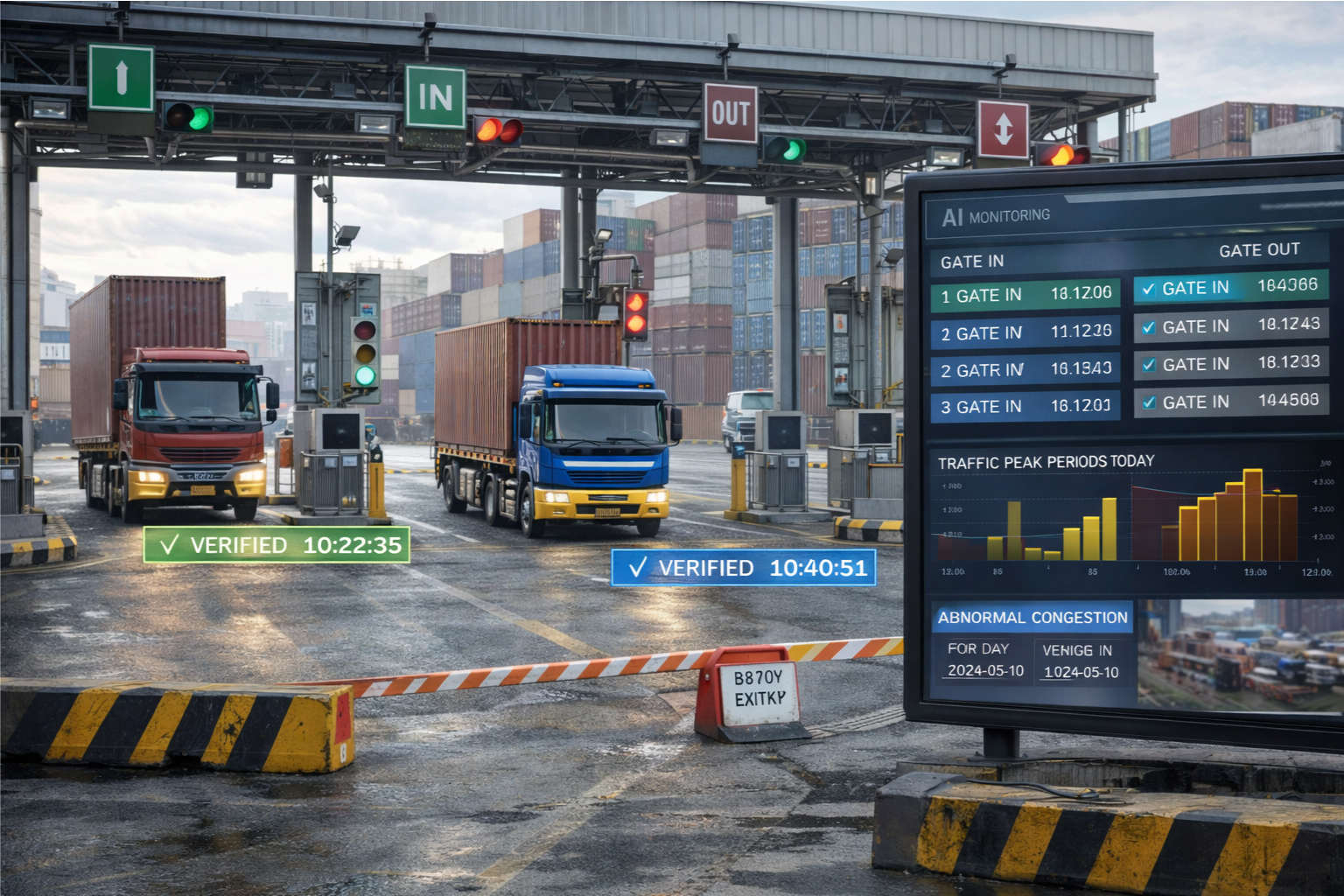
Gate In / Gate Out Event Records
Scenario | Container Trucks Entering and Exiting the Port
A large number of container trucks enter and exit the port daily. Although the process appears simple, it is often difficult in practice to accurately understand traffic volume and congestion conditions.
Traditional Situation
– Vehicle entry and exit times rely largely on manual card swiping or manual logging
– Congestion frequently occurs during peak periods, but root causes are unclear
– Post-event analysis often relies on subjective impressions
After Implementation
– Each vehicle’s Gate In and Gate Out times are recorded as event data
– Management units can clearly identify:
– Peak entry and exit periods
– Abnormal congestion on specific days
– Whether delays are related to inspections, weather, or other factors
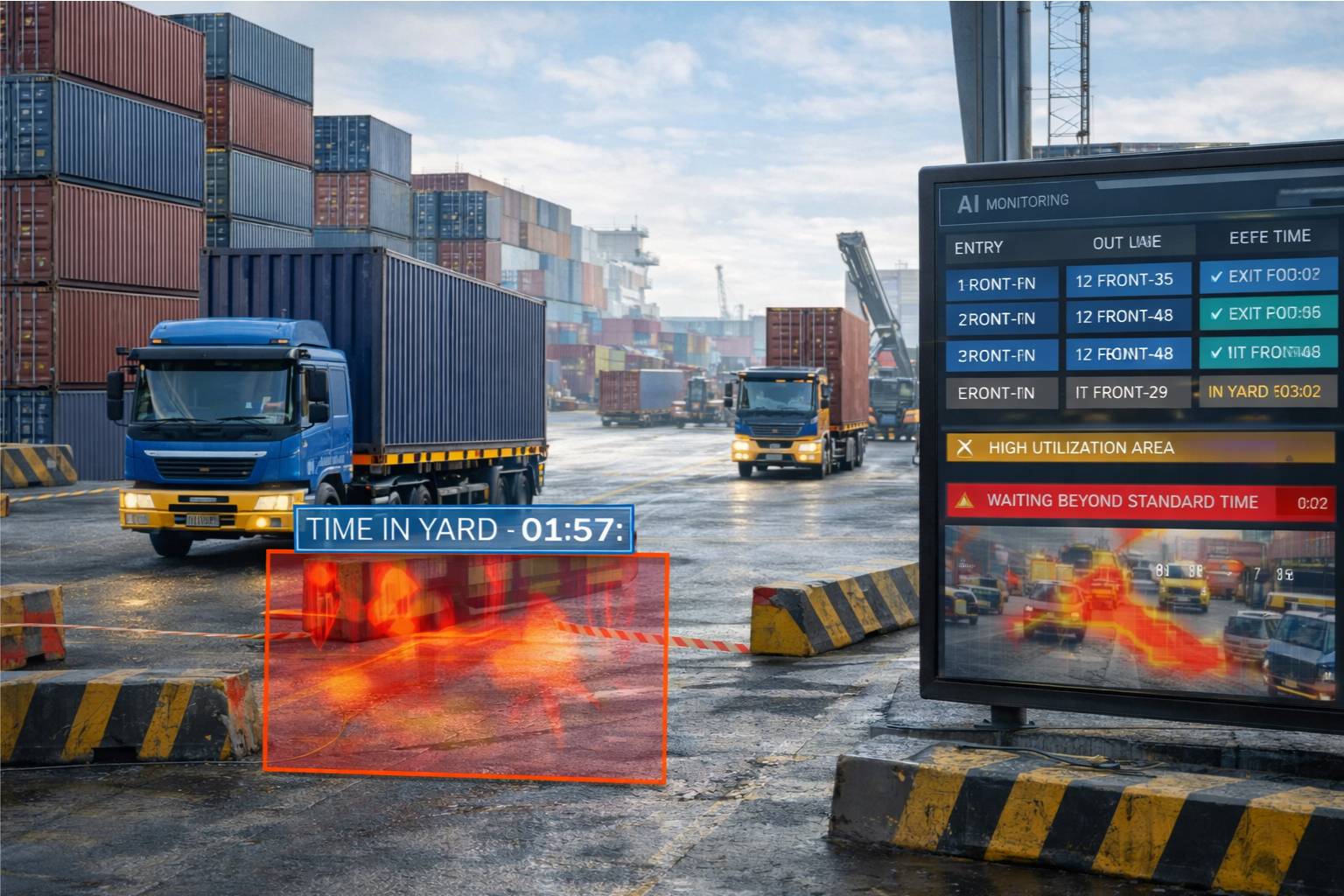
Yard Entry, Dwell Time, and Waiting Events
Scenario | Container Handling and Temporary Storage in the Yard
Once containers enter the yard, their dwell time and handling efficiency directly affect overall operational smoothness.
Traditional Situation
– Actual container dwell times are difficult to determine
– Congestion and re-handling issues are usually reviewed only after the fact
After Implementation
– Yard entry, exit, and dwell times are recorded as event data
– Management units can analyze:
– Areas with persistently high utilization
– Time periods prone to waiting and congestion
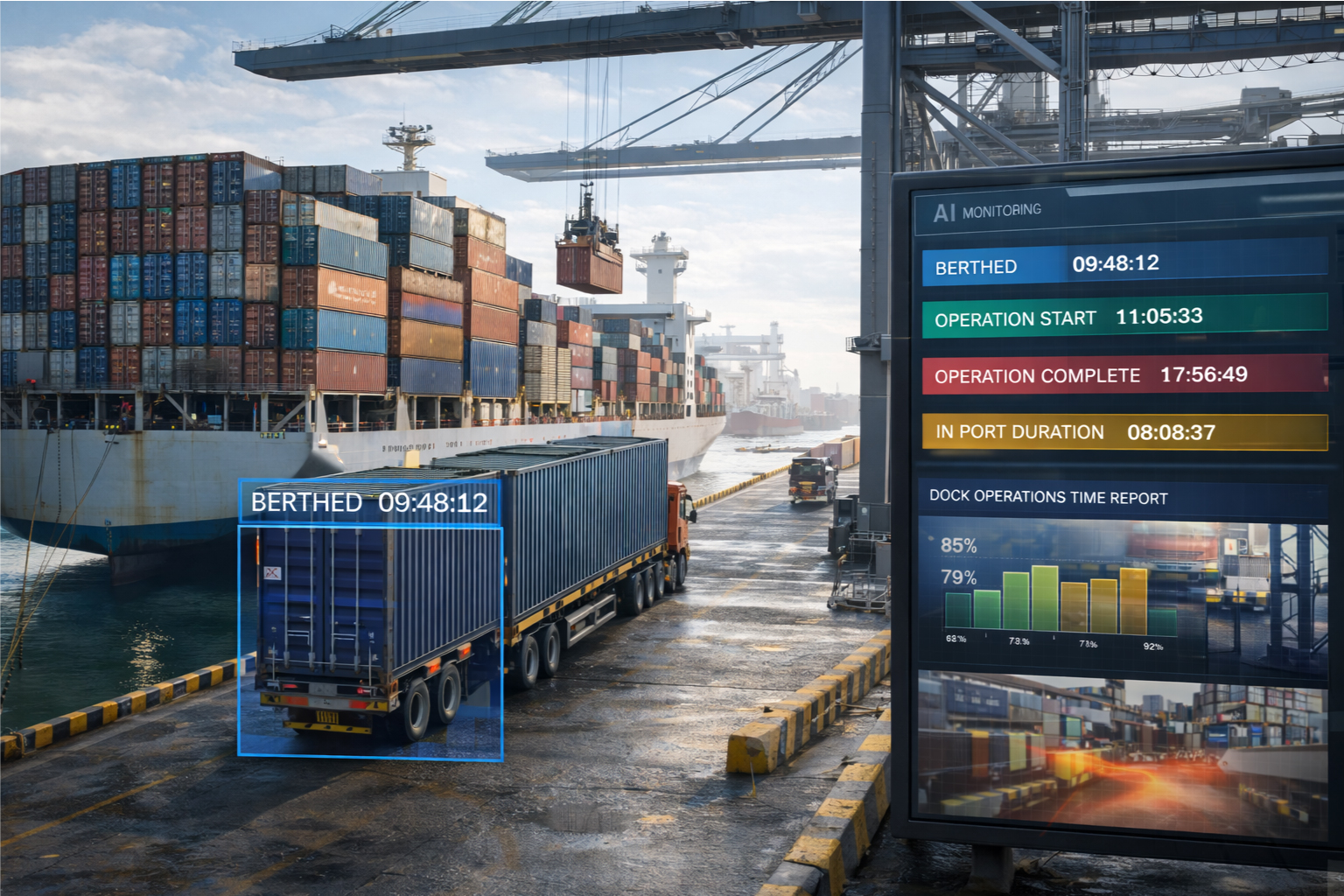
Berth Operation Time Stamping
Scenario | Vessel Berthing and Cargo Operations
Vessel berthing and cargo operations involve coordination among multiple parties. Without clear time records, discrepancies in operational understanding can arise.
After Implementation
– Berthing, operation start, and completion times are recorded with timestamps
-These records support subsequent efficiency analysis and coordination improvements
❖ Management Value
– Shifts operational management from experience-based to fact-based decision-making
– Provides a shared operational reference across departments
– Serves as a critical data foundation for efficiency improvement and expansion evaluation
Real-Time Operational Command Dashboard Module
Positioning Description
This module serves as the integrated visual entry point for port management. Its core purpose is not to increase the number of monitoring screens, but to consolidate information previously scattered across different departments and systems into a single management interface. Through real-time aggregation and contextual presentation, it enables management units to quickly grasp overall port conditions while reducing information gaps and communication costs.
❖ Management Value
– Reduces management blind spots caused by fragmented information
– Enhances cross-department coordination and real-time decision-making
– Improves clarity for external communication and internal briefings
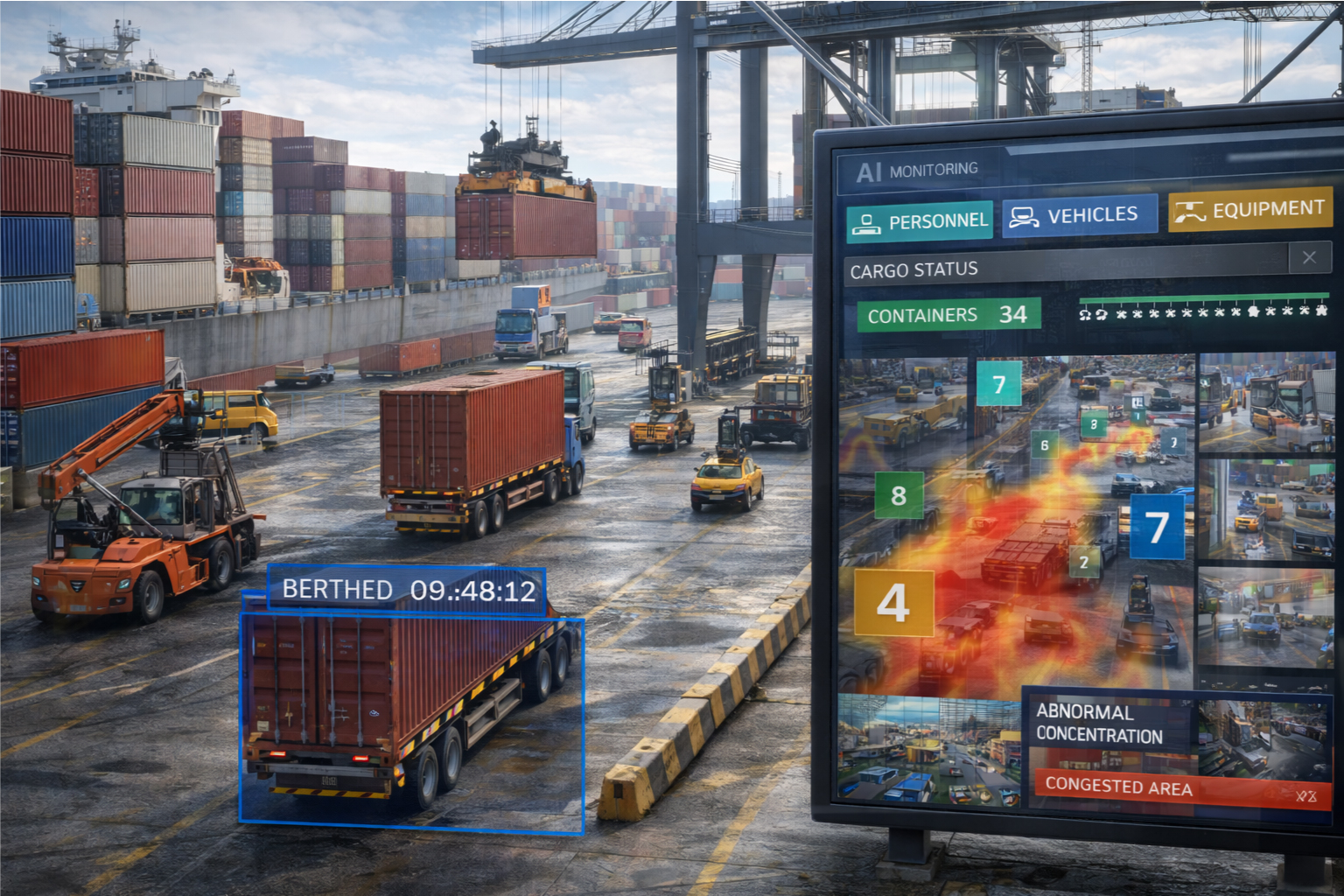
Real-Time Status of Personnel, Vehicles, Cargo, and Equipment
Scenario | Daily Operational Peak Periods
During peak operational periods, large numbers of personnel, vehicles, containers, and operating equipment coexist within the port, creating a highly dynamic environment.
Traditional Situation
– Each department holds only partial information
– Managers must rely on multiple systems or phone calls to piece together the overall situation
After Implementation
– A single interface displays:
– Distribution of personnel and vehicles
– Real-time status of containers and equipment
-Managers can quickly identify congestion or abnormal concentration areas
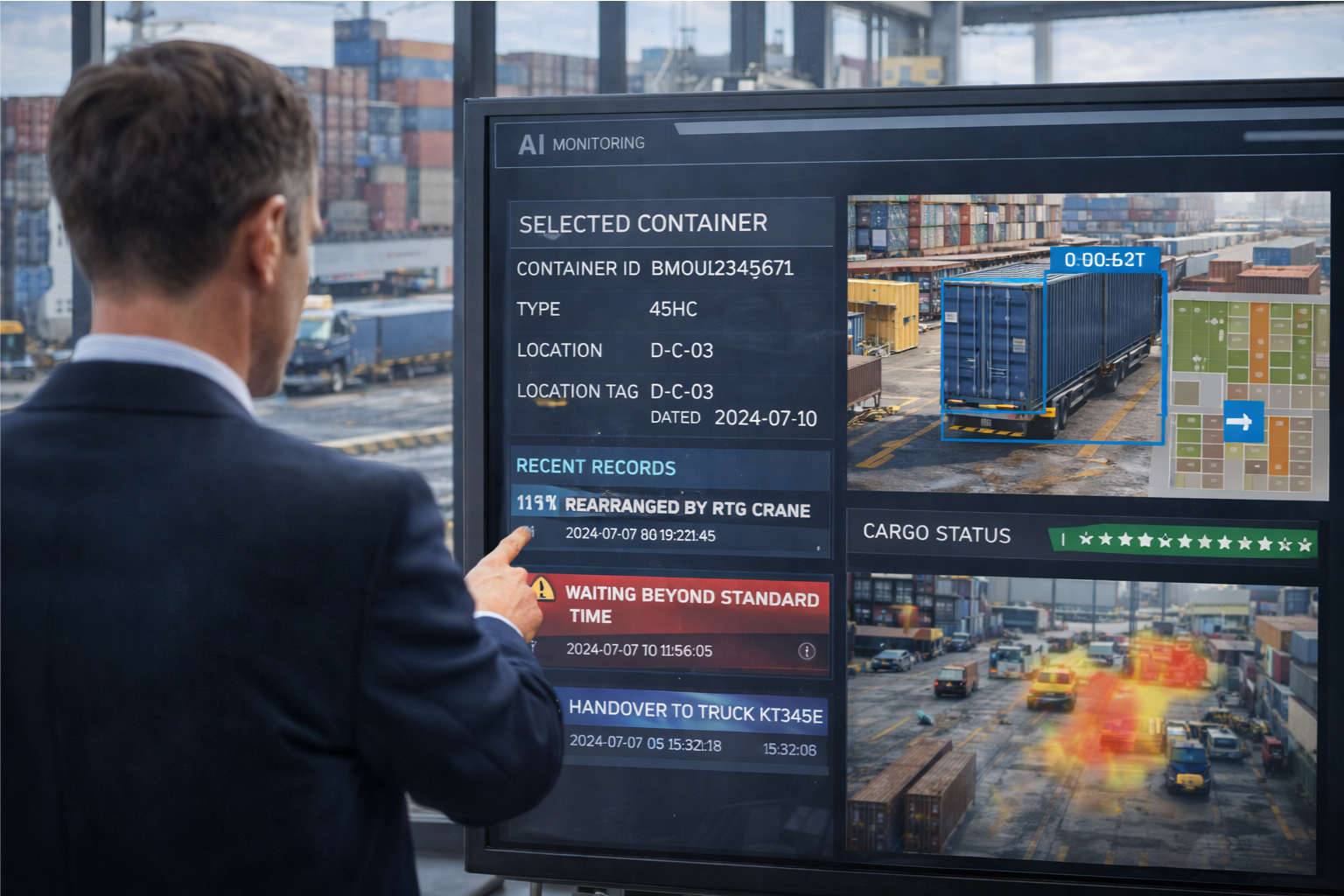
Contextualized Object Information Display
Scenario | Manager Reviewing a Specific Container or Equipment
When managers select a specific container, vehicle, or piece of equipment on the dashboard, they often need immediate access to its contextual information.
After Implementation
– Selecting an object displays:
– Basic identification information
– Current location
– Related operational or anomaly records
– Eliminates the need to repeatedly switch between systems
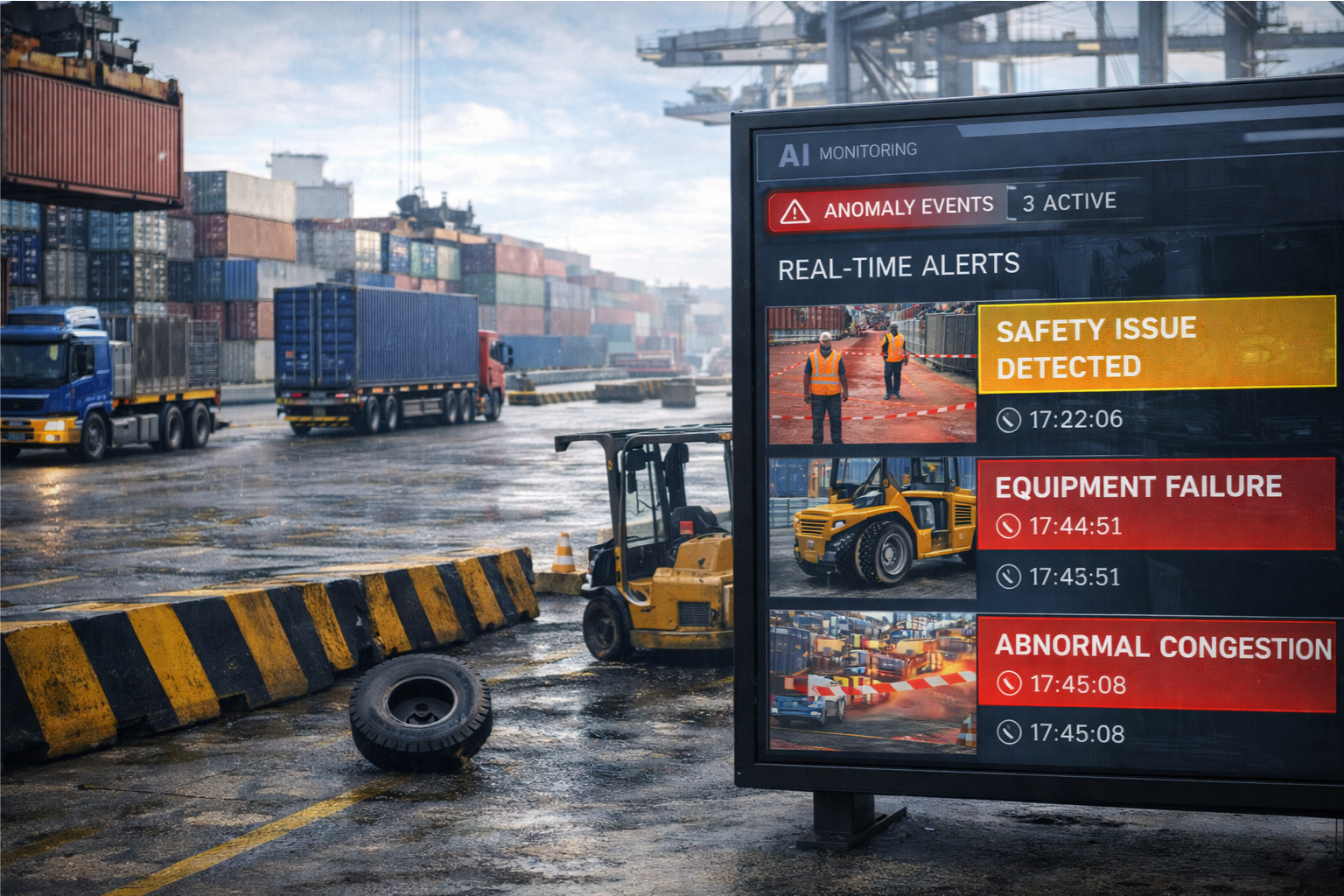
Real-Time Aggregation of Anomaly Events
Scenario | Multiple Departments Reporting Issues Simultaneously
Within the same time frame, the port may experience safety, equipment, and operational anomalies simultaneously.
Traditional Situation
– Anomaly information is scattered across departments
– Managers struggle to prioritize responses in real time
After Implementation
– All anomaly events are consolidated on the dashboard
– Management units can immediately assess overall risk conditions
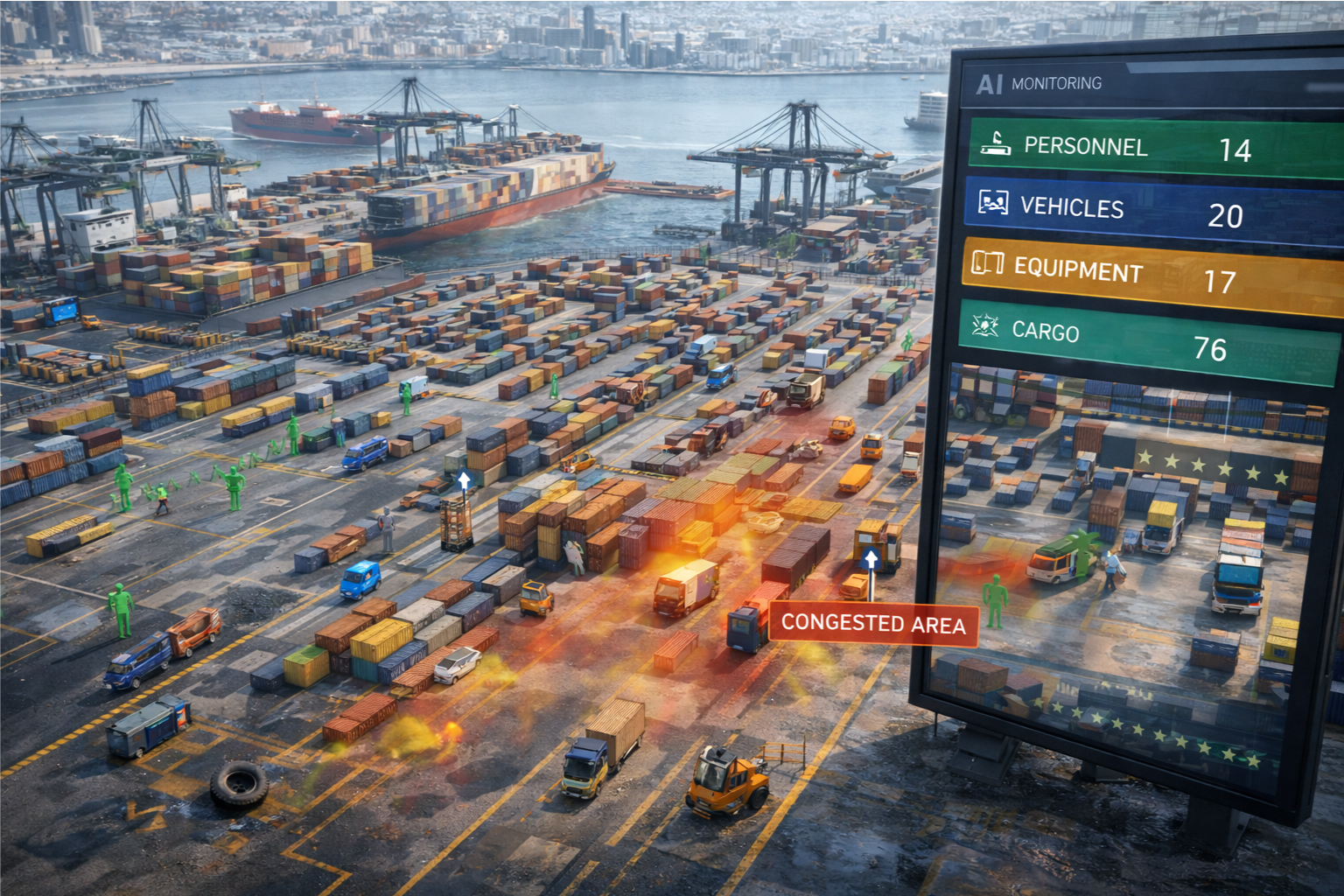
3D Port Situation Visualization
Scenario | Cross-Department Briefings or Government Inspections
For decision-makers unfamiliar with port layouts and spatial arrangements, traditional 2D maps often fail to convey real-world conditions effectively.
After Implementation
– Port layouts are presented using 3D visualization
– Real-time overlays of personnel, vehicles, cargo, and equipment
– Enables rapid comprehension of overall port conditions
Container Exterior Damage Assessment Module
Positioning Description
This module is positioned to assist management units in tracking changes in container exterior conditions across operational nodes within the port. Through image-assisted assessment, it establishes a traceable record foundation. The purpose is not to determine liability in real time, but to reduce dispute risks arising from information asymmetry.
❖ Management Value
– Reduces disputes and unclear liability related to container exterior conditions
– Provides objective and traceable management references
– Does not alter existing workflows or responsibility structures
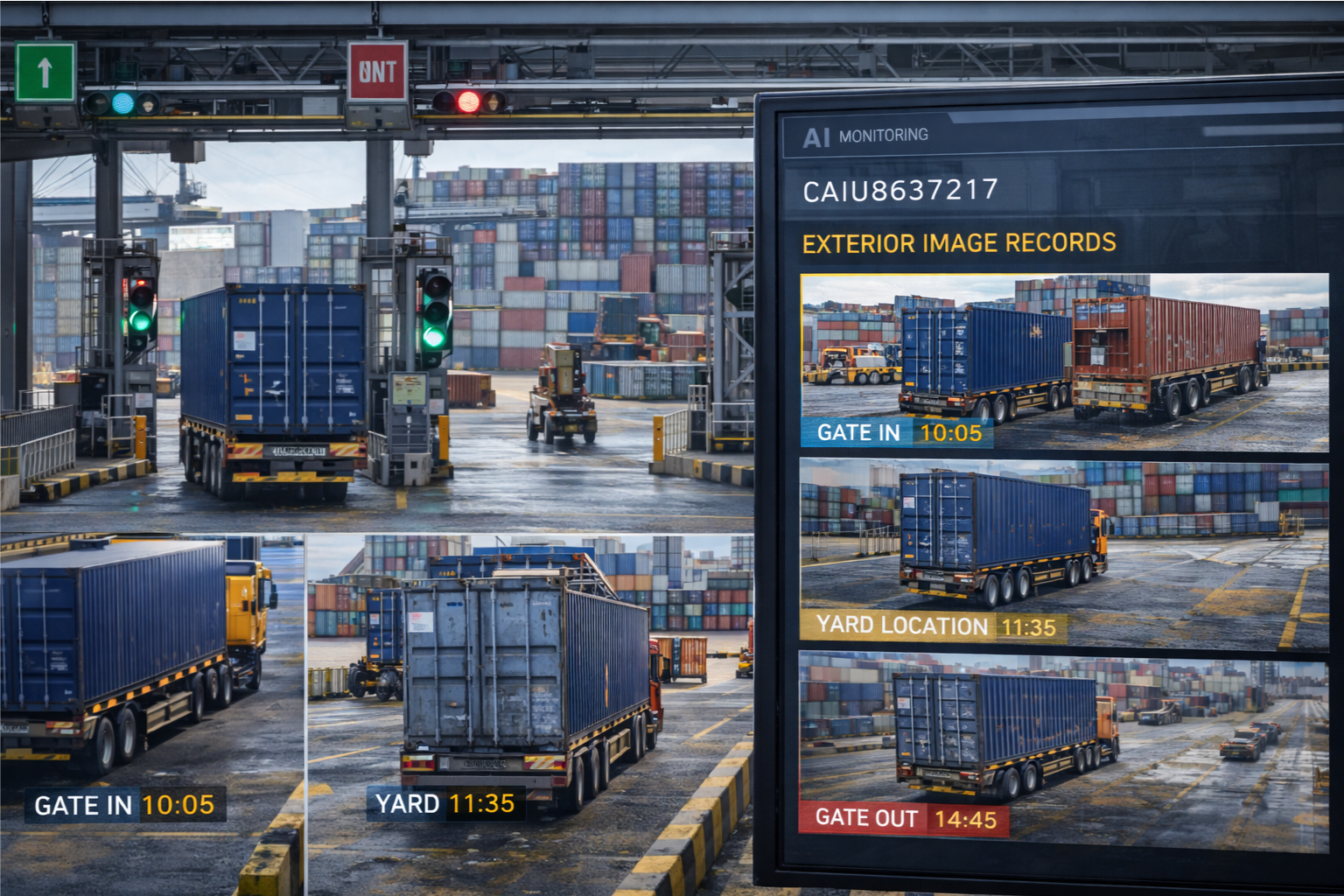
Container Image Collection at Gates and Yards
Scenario | Container Entry, Exit, and Yard Operations
As containers pass through gates and enter yard operations, their exterior condition may vary due to transportation or handling.
After Implementation
– The system collects container exterior images at gate and yard nodes
– Exterior records are established for each container at different time points
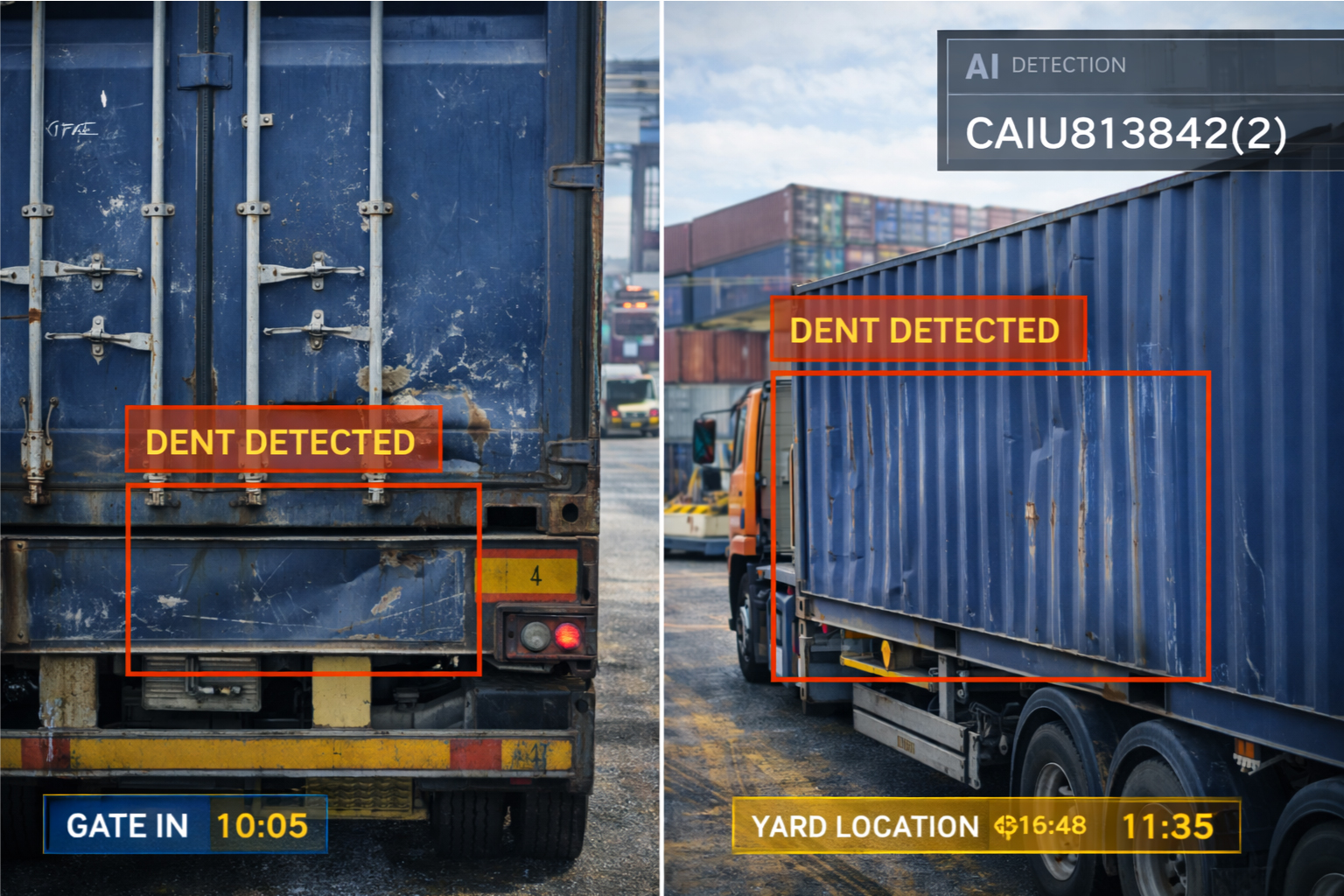
Identification of Visible Dents and Deformations
Scenario | High-Volume Container Turnover
Under high operational volume, manually inspecting each container’s exterior becomes challenging.
After Implementation
– The system assists in flagging visible dents or side panel deformations
-Serves as a reference for subsequent manual verification by management
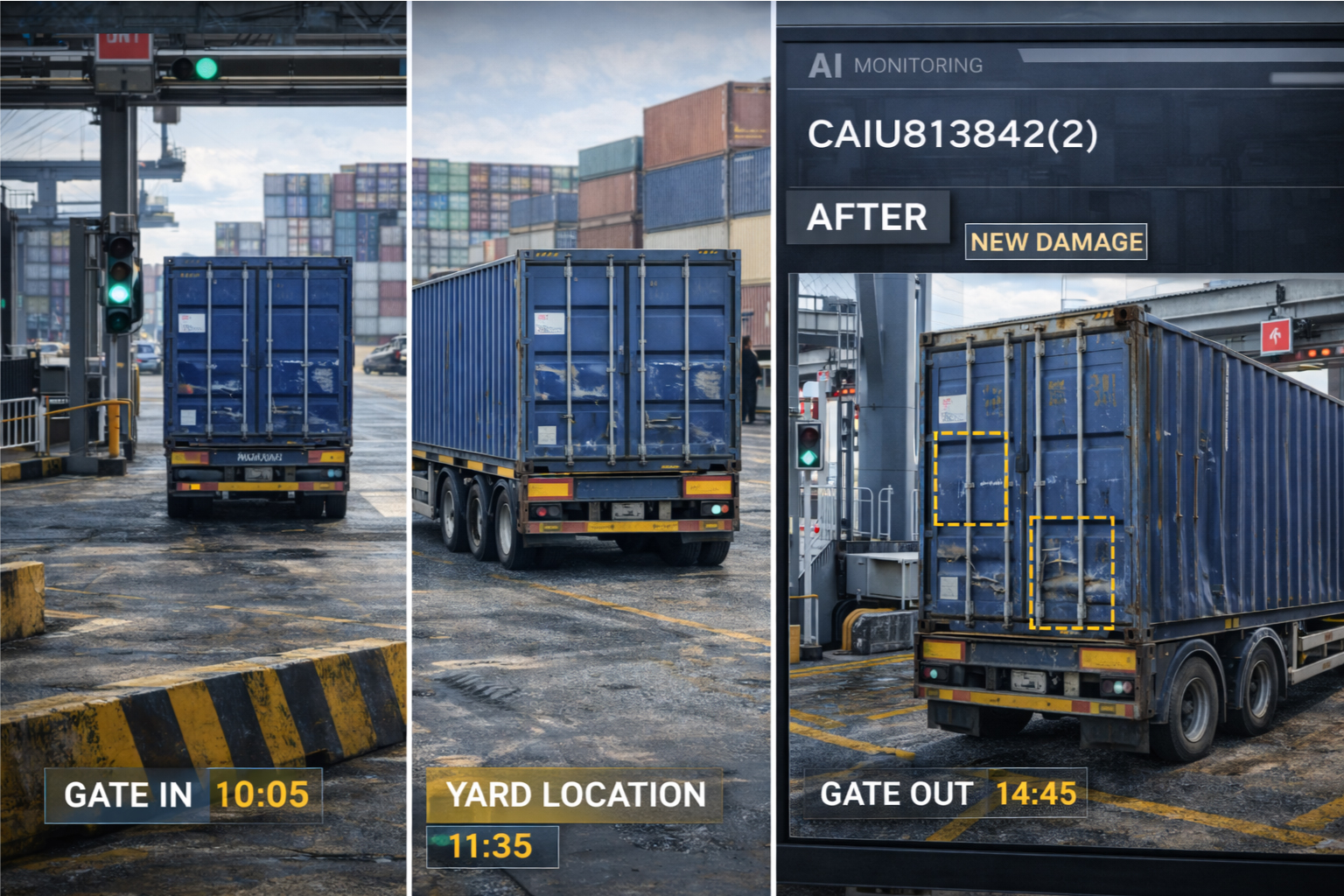
Before-and-After Condition Comparison
Scenario | Condition Review Prior to Container Exit
After passing through multiple operational nodes within the port, a container’s exterior condition may change.
After Implementation
– Images captured at entry, yard, and exit stages can be compared
– Enables assessment of whether new damage may have occurred within the port
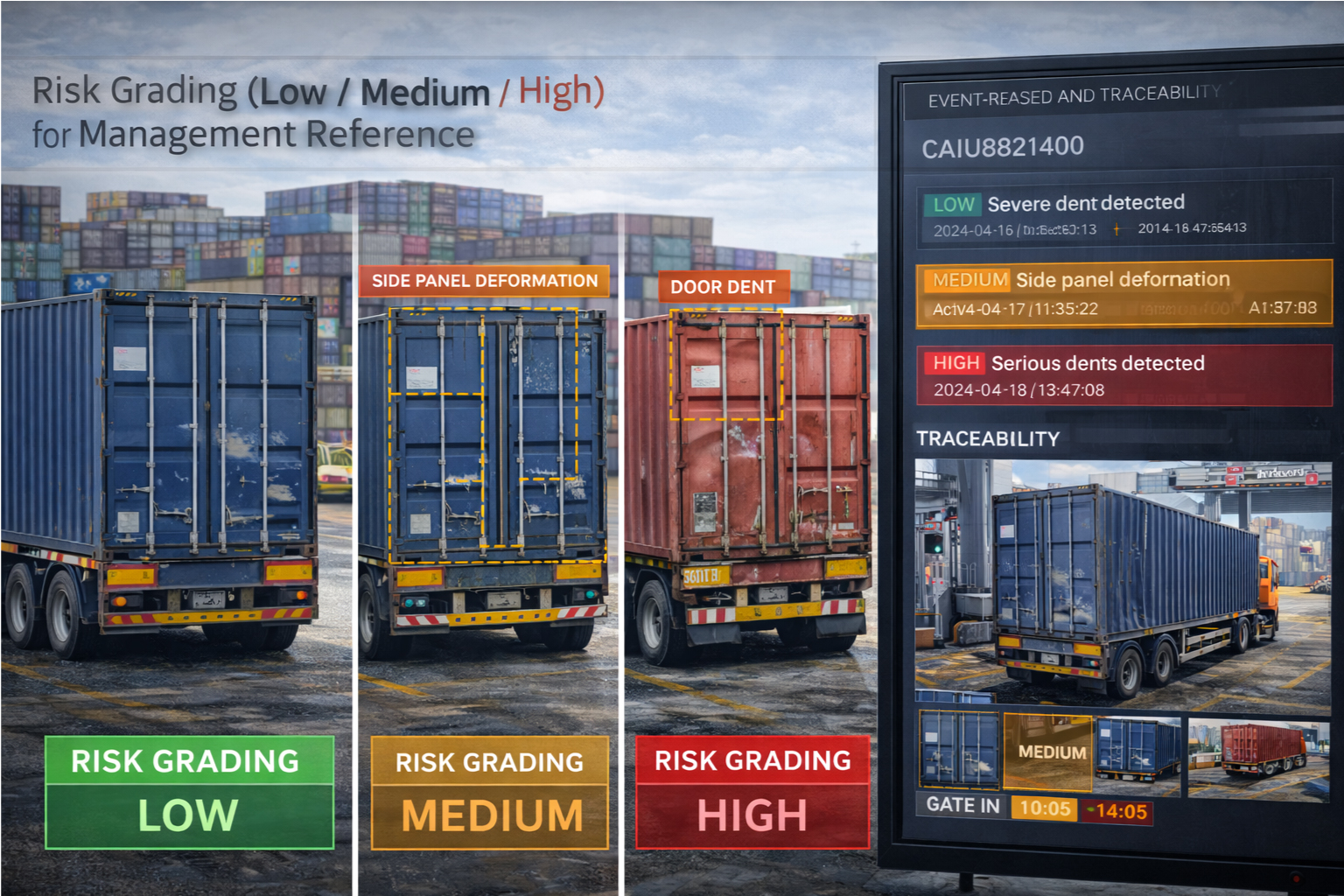
Risk Grading (Low / Medium / High) for Management Reference
The system provides preliminary risk grading based on the severity of exterior anomalies, assisting management in prioritizing containers that require attention.
Event-Based Records and Traceability
All container damage-related conditions are stored as event records, enabling future retrieval and explanation.
Equipment Status and Anomaly Monitoring Module
Positioning Description
This module is positioned to assist management units in monitoring the operational status and early anomaly signs of key port equipment in real time. It shifts equipment management from reliance on manual reporting or post-maintenance records to an event-based management perspective. The objective is not to intervene in equipment operation or enable automatic control, but to enhance management visibility and risk awareness.
❖ Management Value
– Enhances timeliness and transparency of equipment management
– Reduces operational impact from unexpected failures
– Provides reference data for maintenance scheduling and equipment investment decisions
– Does not alter existing equipment operation or responsibility structures
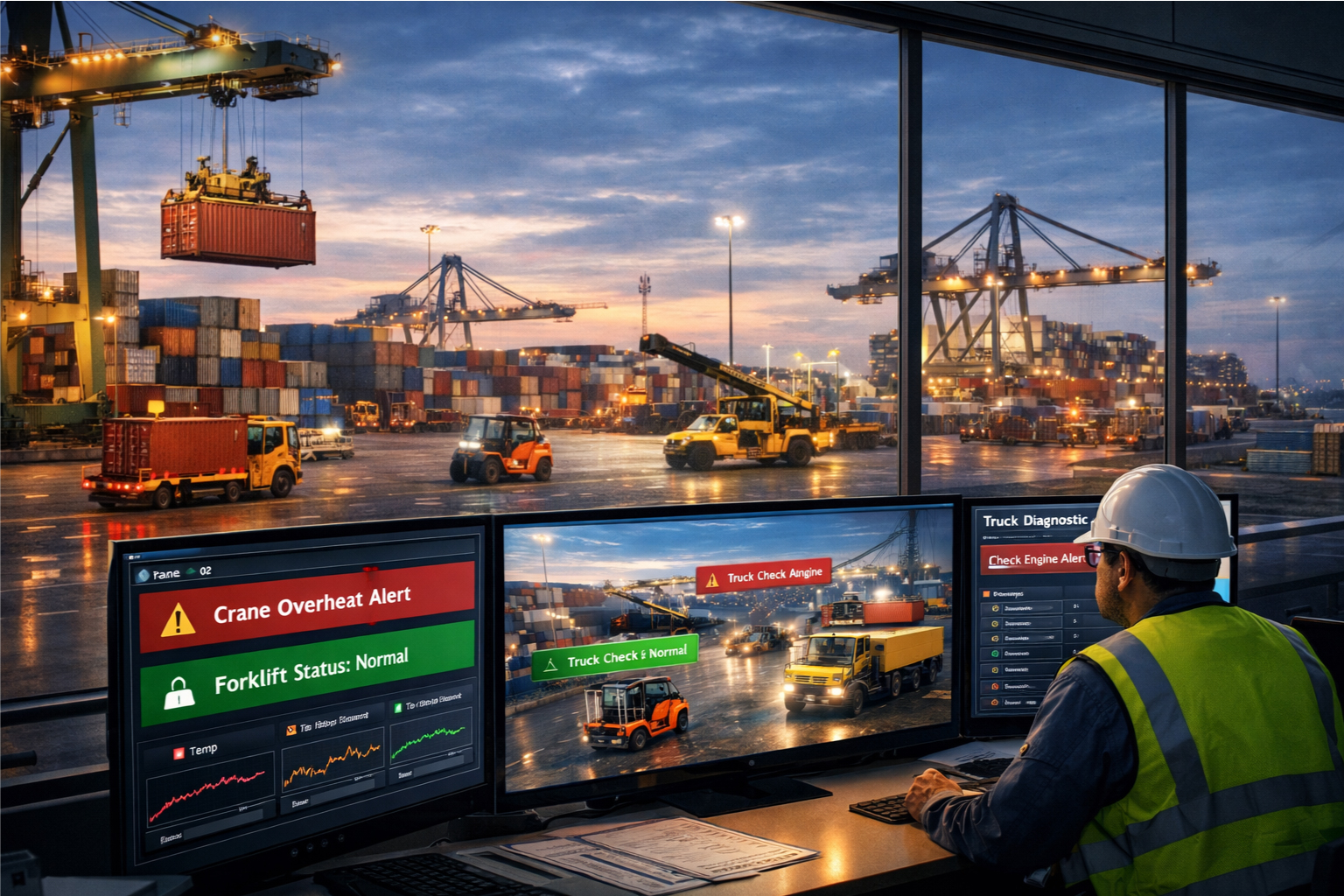
Status Collection of Cranes, Vehicles, and Critical Equipment
Scenario | Continuous Cargo Handling Operations
Cranes, forklifts, and terminal vehicles within the port often operate under prolonged high-load conditions, with their operational status directly affecting safety and efficiency.
After Implementation
– The system continuously collects equipment operational status
– Management units can monitor prolonged operation or abnormal conditions
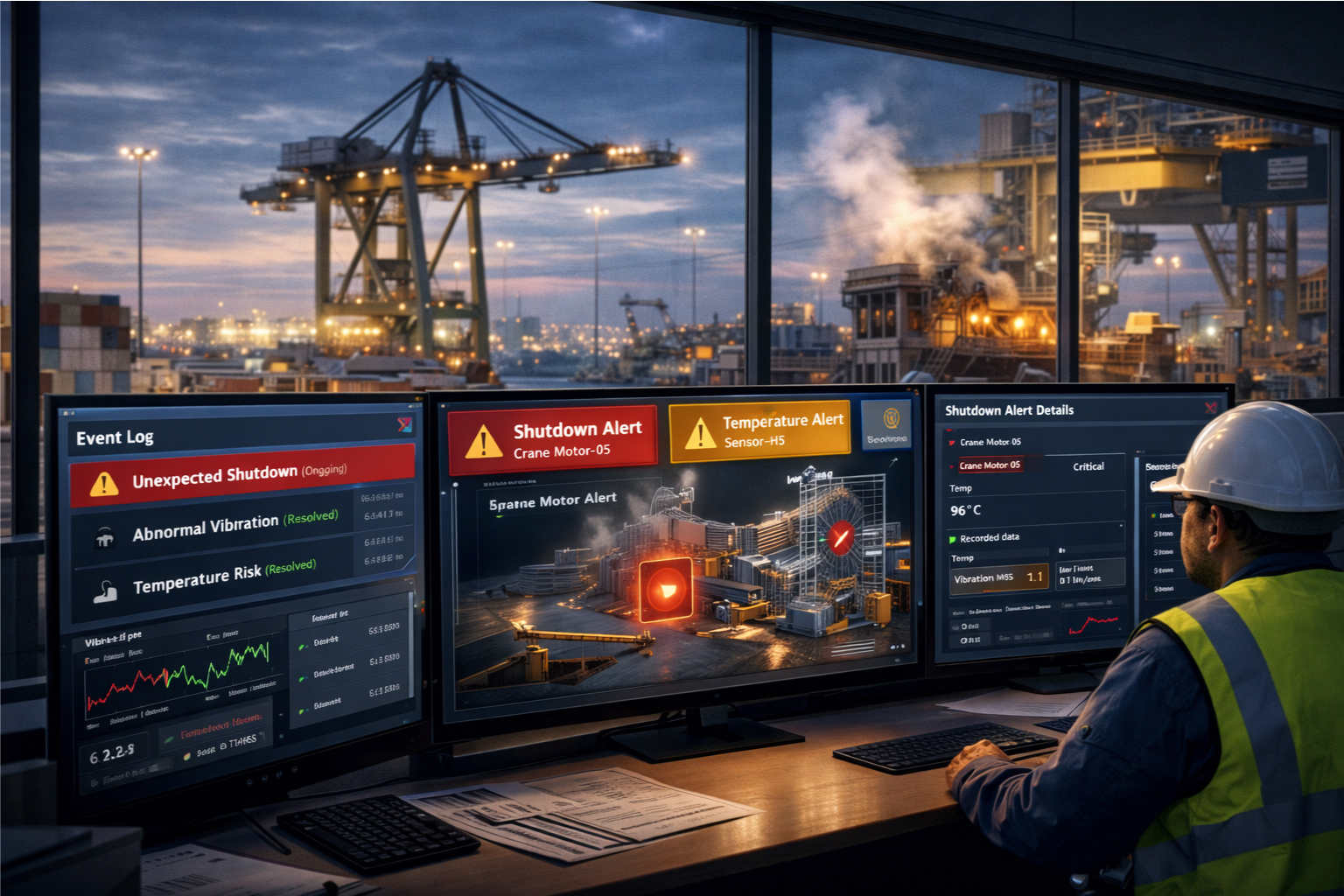
Event Recording and Alerts for Shutdowns, Abnormal Vibration, and Temperature Rise
Scenario | Equipment Showing Early Anomaly Signs
Before actual failure occurs, equipment often exhibits signs such as unexpected shutdowns, abnormal vibration, or temperature increase.
After Implementation
– When such anomalies occur, the system will:
– Record complete event data
– Provide real-time alert notifications on the management interface
– Management units can immediately identify affected equipment and status
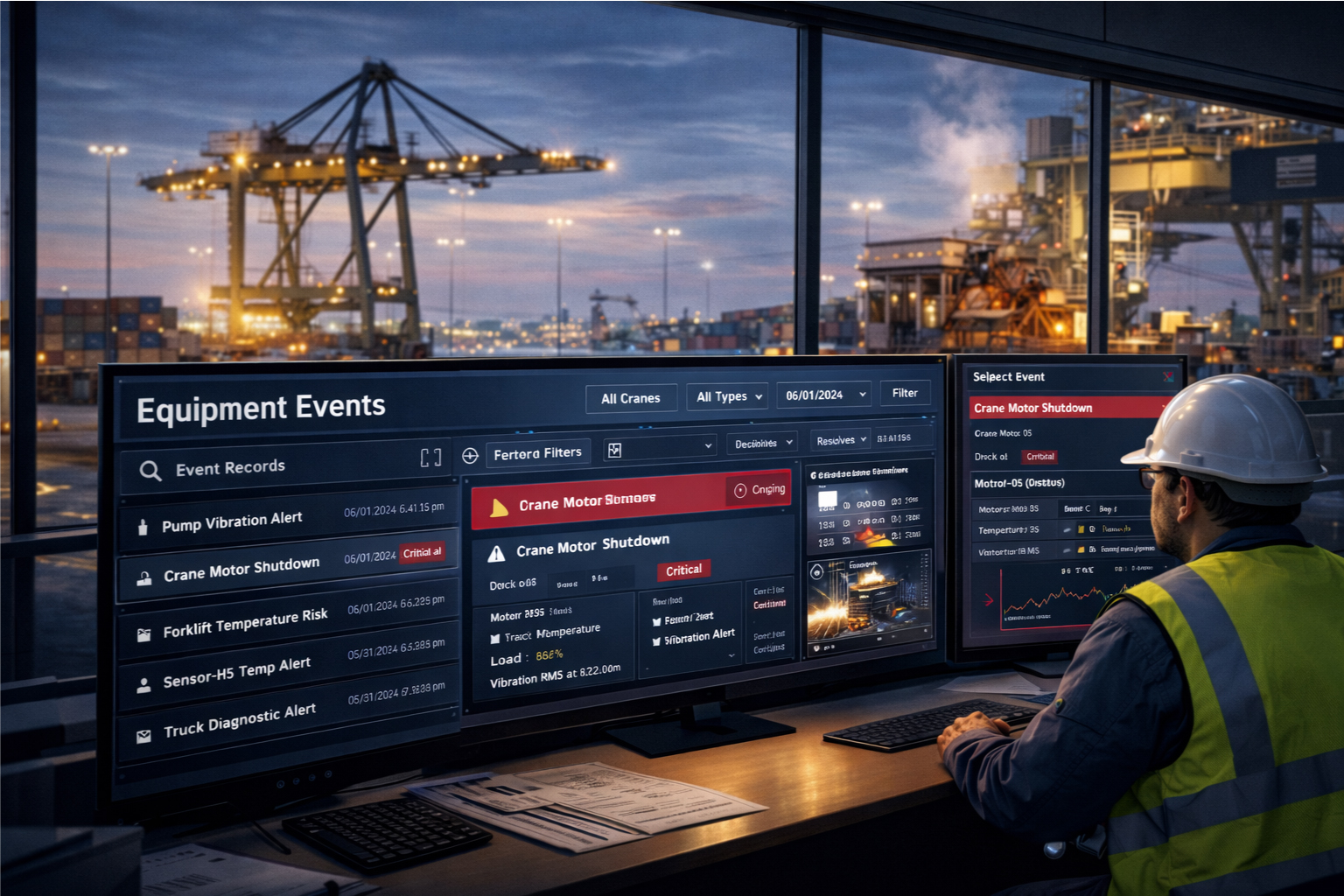
Event-Based Equipment Status Records and Query
All equipment status and anomalies are converted into queryable event data, supporting maintenance review and management analysis.
ESG (Environmental × Social × Governance) Eventization Module
Positioning Description
This module is positioned to convert port energy usage and environmental conditions into manageable and traceable event data, enabling management units to monitor energy, environmental, and sustainability-related risks without disrupting existing operations. Its purpose is not to intervene in real-time equipment operation, but to provide objective and queryable management references that support regulatory compliance, public concerns, and sustainability disclosures.
❖ Management Value
– Assists government agencies in monitoring port energy and environmental conditions
– Provides traceable records for environmental management and explanation
– Supports sustainability policies and external disclosure requirements
– Does not interfere with existing workflows or equipment operations
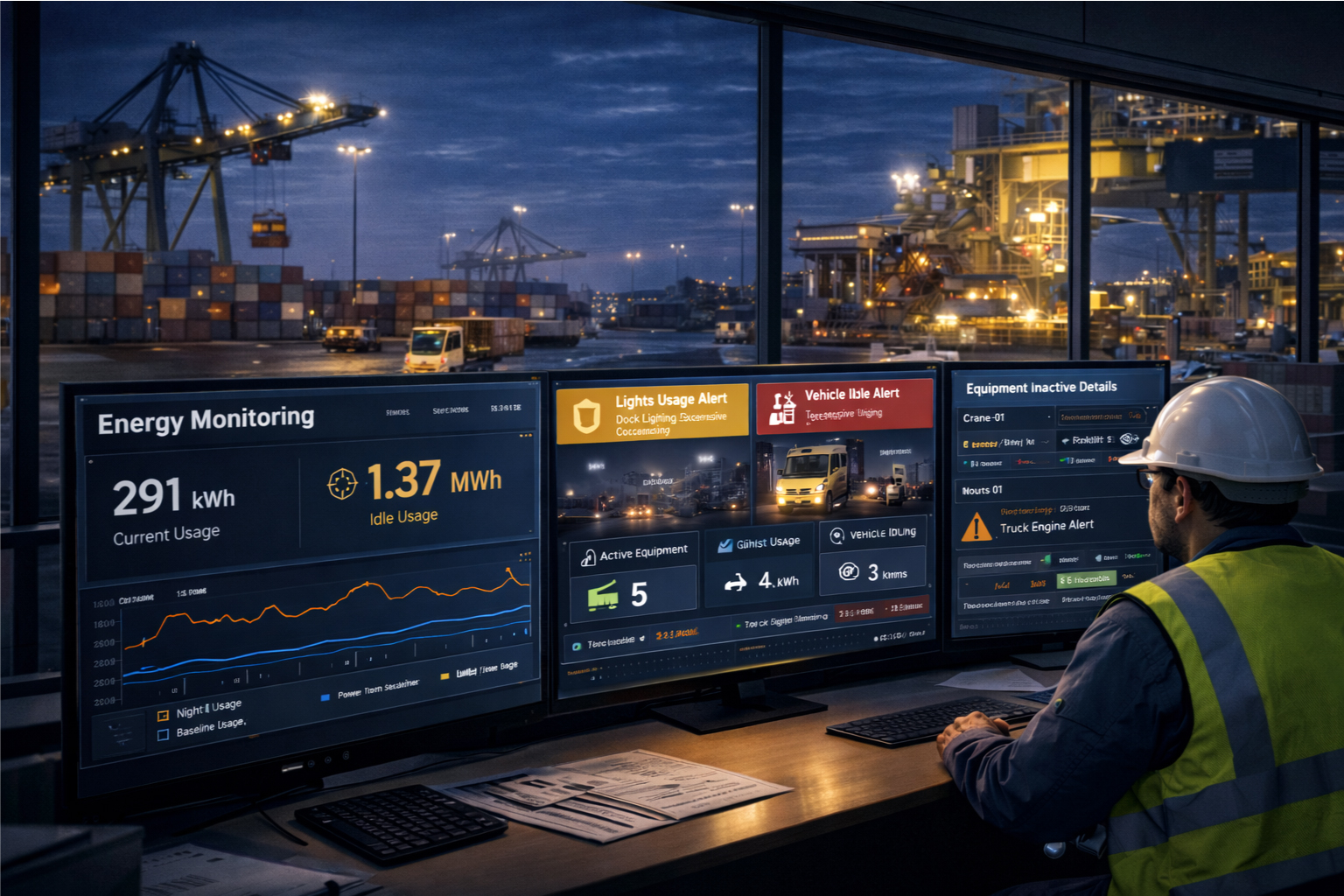
Power Consumption and Equipment Idle Monitoring
Scenario | Nighttime and Off-Peak Port Operations
During nighttime or low-activity periods, equipment may remain powered on, vehicles may idle, and lighting systems may operate continuously within the port.
After Implementation
– The system continuously collects power consumption and equipment idle status
– Management units can identify abnormal energy usage or unnecessary operation
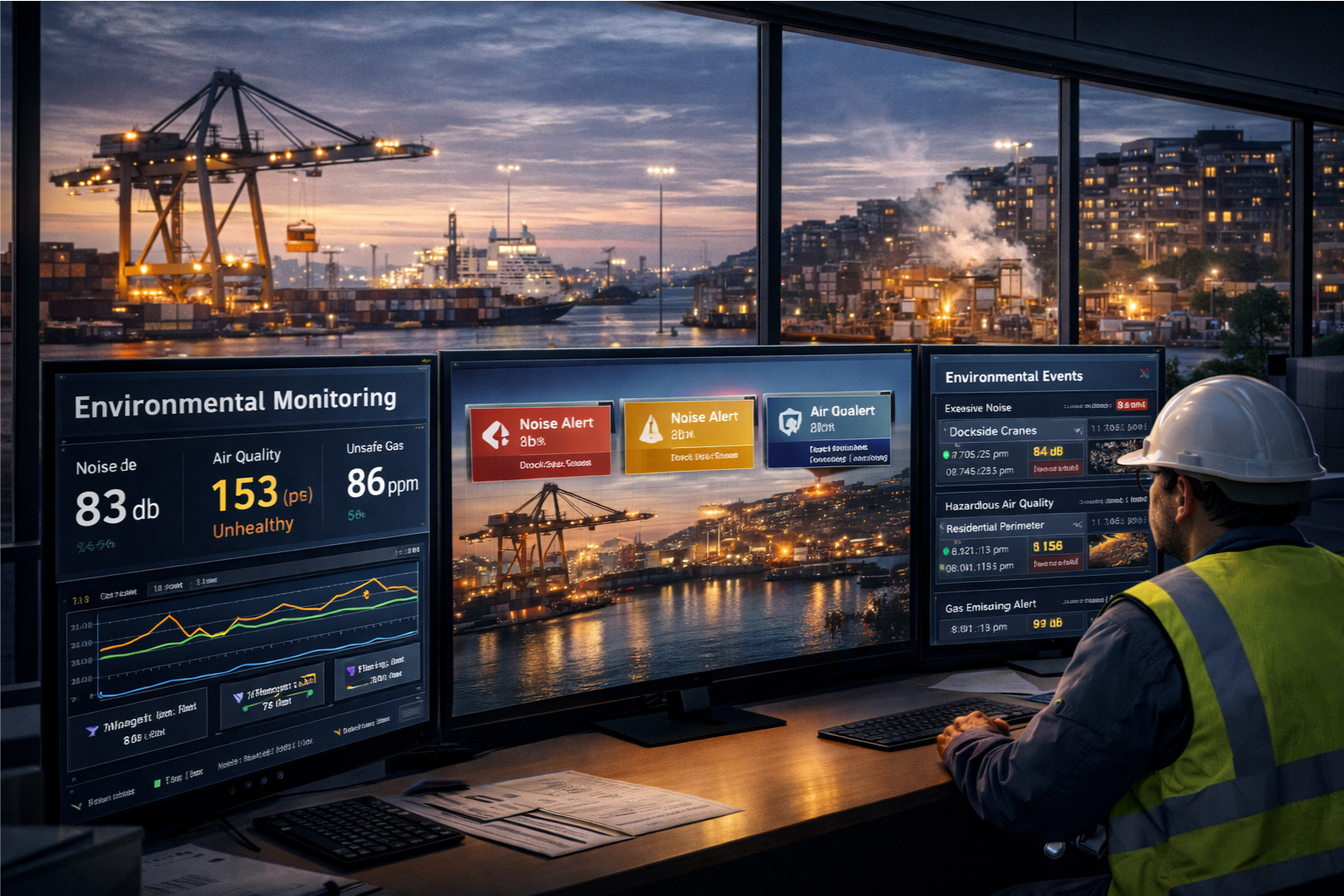
Noise, Air Quality, and Gas Detection Data Collection
Scenario | Port Operations and Surrounding Areas
Port operations may affect surrounding areas through noise and air quality impacts, and certain operations require monitoring of potential gas emissions.
After Implementation
– The system collects noise levels, air quality indicators, and gas variation data
– Provides reference information for environmental monitoring and follow-up explanations
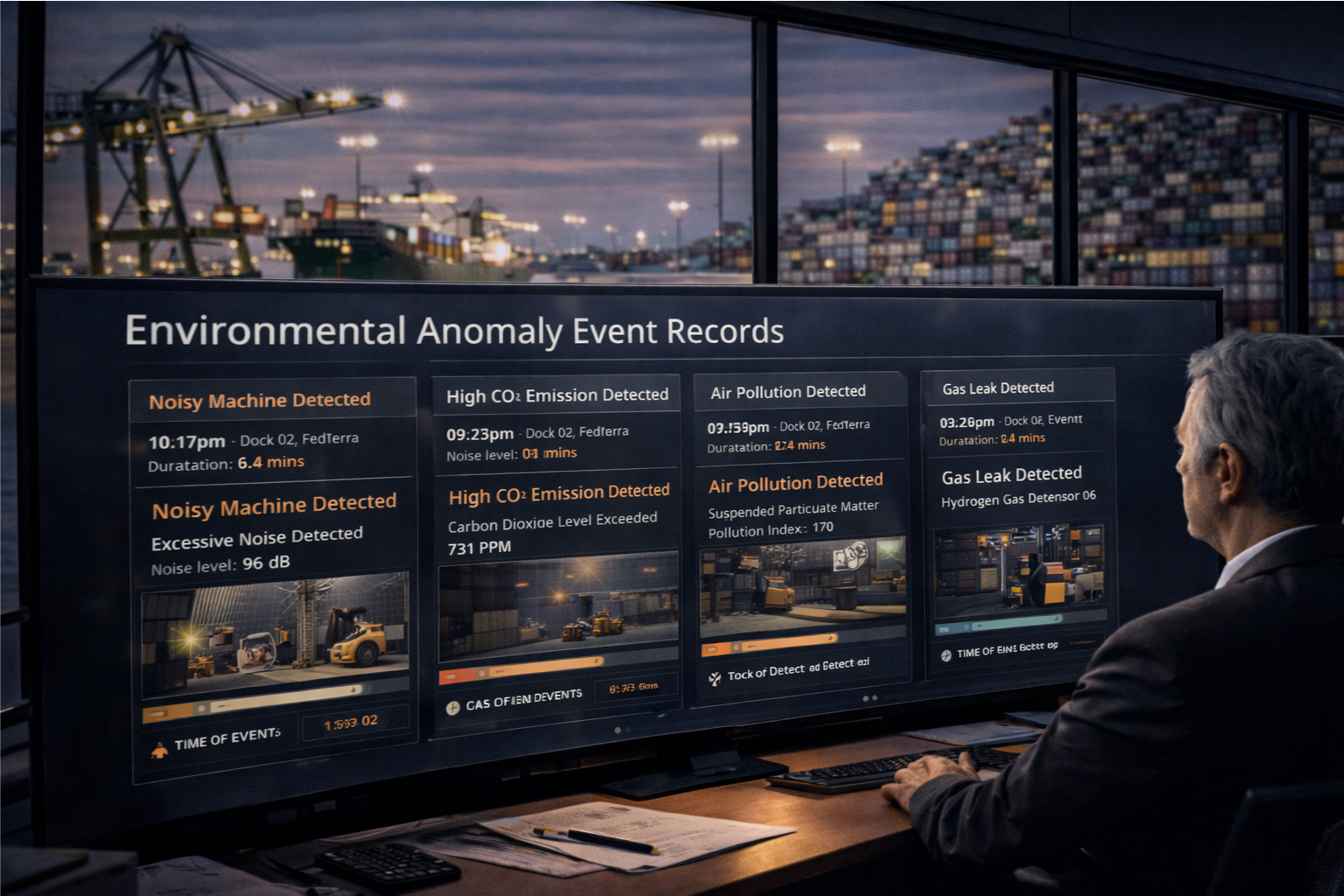
Environmental Anomaly Event Records
When abnormal noise, air quality, or gas conditions are detected, the system converts them into event records, indicating occurrence time, location, and duration for future reference and explanation.
Event-Driven AI Risk Hotspot Analysis Module
Positioning Description
❈ Differentiation technology
This module is positioned to integrate various event-based data within the port to identify areas and time periods where risks are concentrated from a management perspective. Its purpose is not to predict accidents or perform automated judgments, but to help management units review existing events and identify locations and scenarios where issues repeatedly occur, serving as reference for inspections, process improvement, and resource allocation.
❖ Management Value
– Enables management units to move from single-incident reviews to understanding overall risk patterns
– Provides clear references for inspection planning and resource allocation
– Supports continuous improvement and evaluation of management effectiveness
– Does not involve automated judgment or on-site operation
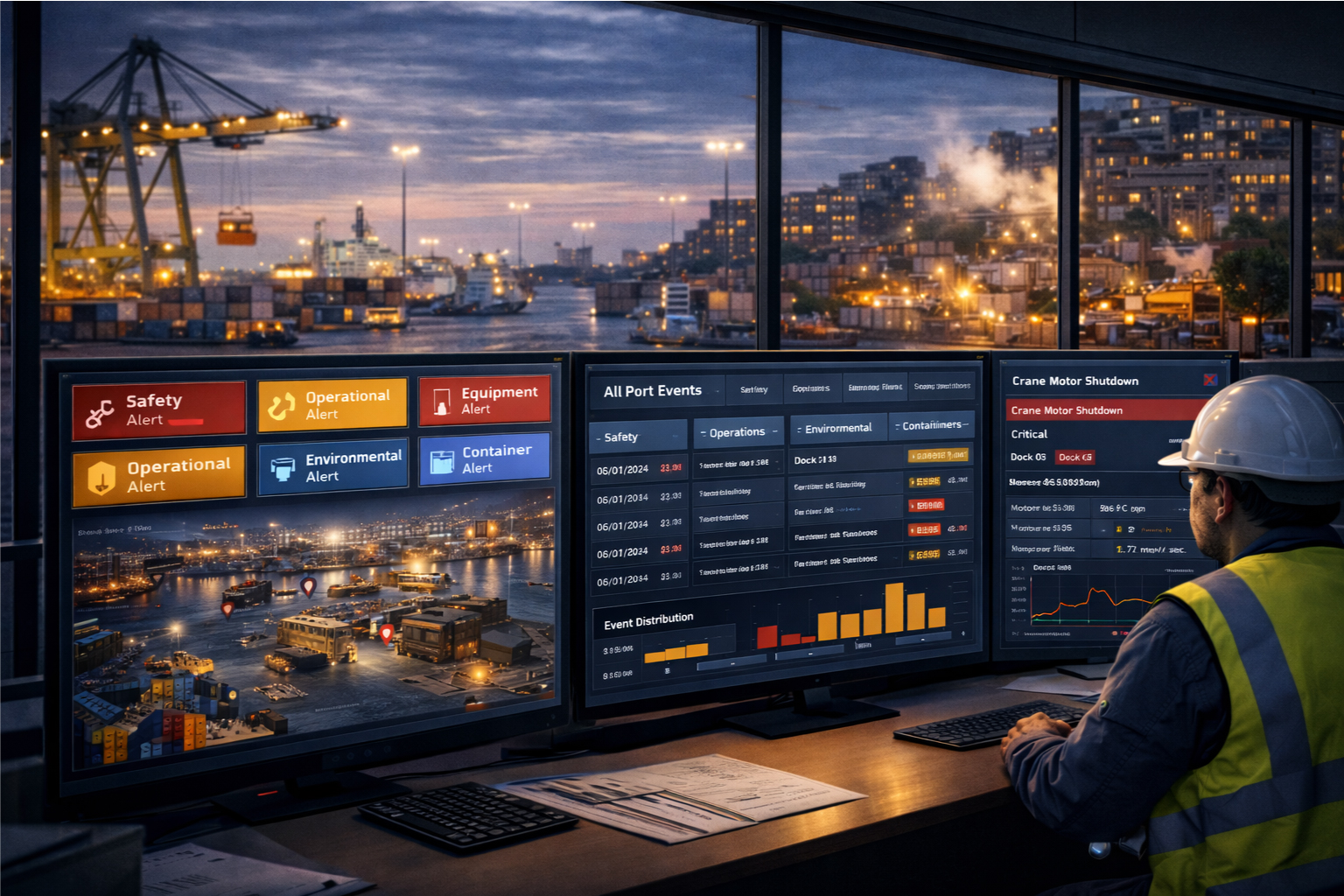
Integration of Safety, Operations, Container Damage, Equipment, and Environmental Events
Scenario | Multiple Types of Issues Occurring Within the Port
During daily operations, the port may simultaneously experience safety incidents, operational delays, equipment anomalies, or environmental-related issues.
After Implementation
– Event data from different domains are consolidated
– Management units can observe event distribution from an integrated perspective
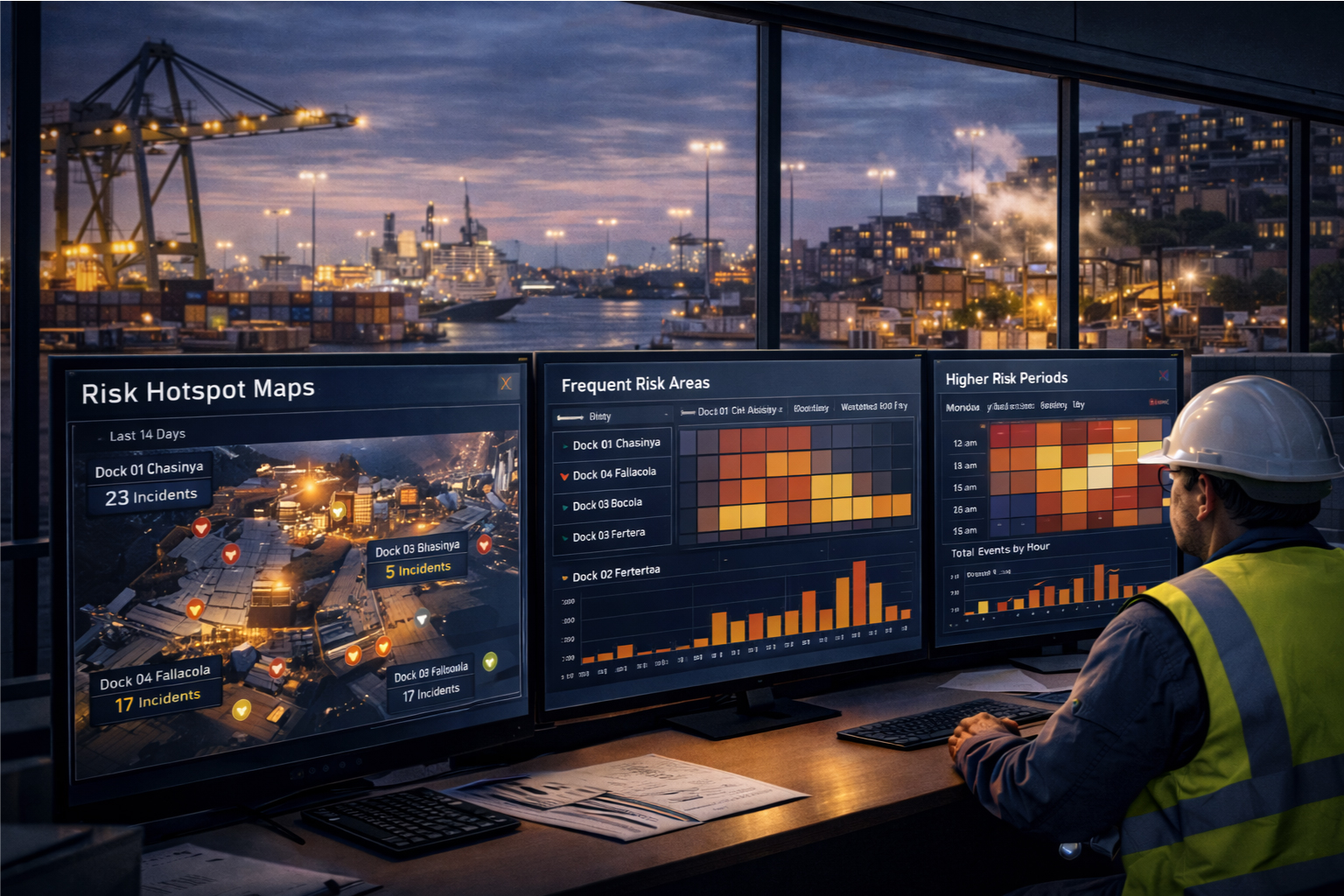
Risk Concentration by Area and Time Period
Scenario | Planning Inspections and Management Priorities
Given the large port area and limited manpower, it is necessary to clearly identify priority locations and time periods.
After Implementation
– The system visualizes risk hotspots based on event location and time
– Management units can identify:
– Areas with frequent issues
– Time periods with higher risk levels
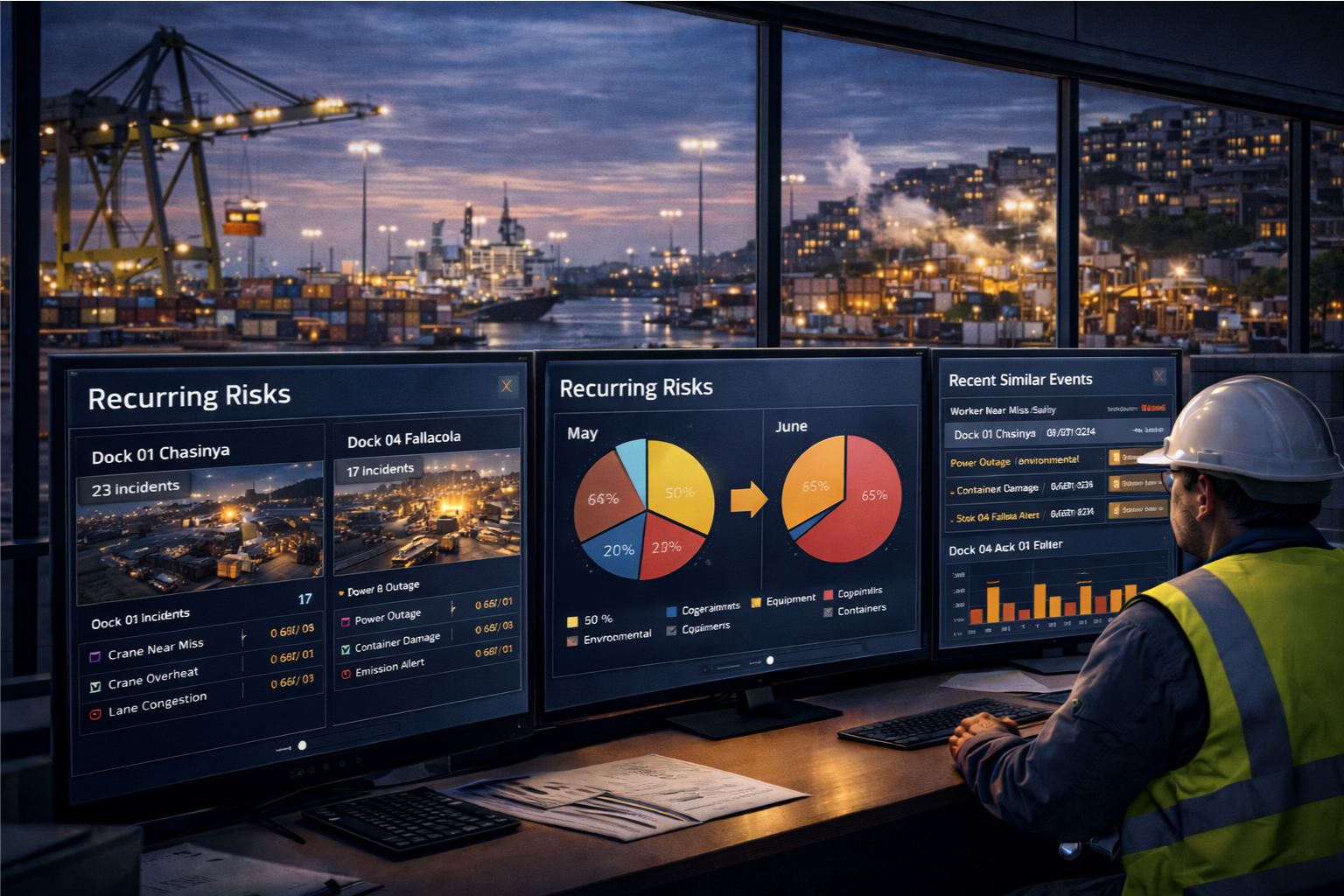
Observation of Recurrent Risk Occurrence
Scenario | Reviewing Effectiveness of Improvement Measures
After implementing improvement measures for specific issues, it is necessary to verify whether the problems have been reduced or continue to recur.
After Implementation
– Management units can observe whether similar events recur in the same areas or categories
– Serves as a basis for adjusting management strategies and improvement measures
Operational Efficiency and Bottleneck Analysis Module
Positioning Description
This module is positioned to make time consumption and waiting conditions within port operational processes explicit, enabling management units to evaluate efficiency based on factual data rather than on-site impressions or isolated feedback. The objective is not to pursue maximum speed, but to identify process nodes and time periods that actually cause delays, serving as a basis for improvement and investment evaluation.
❖ Management Value
– Helps management units identify key nodes that truly affect efficiency
– Provides a basis for process improvement and manpower allocation adjustments
– Supports evaluation of facility expansion or operational adjustments
– Does not involve real-time command or on-site intervention
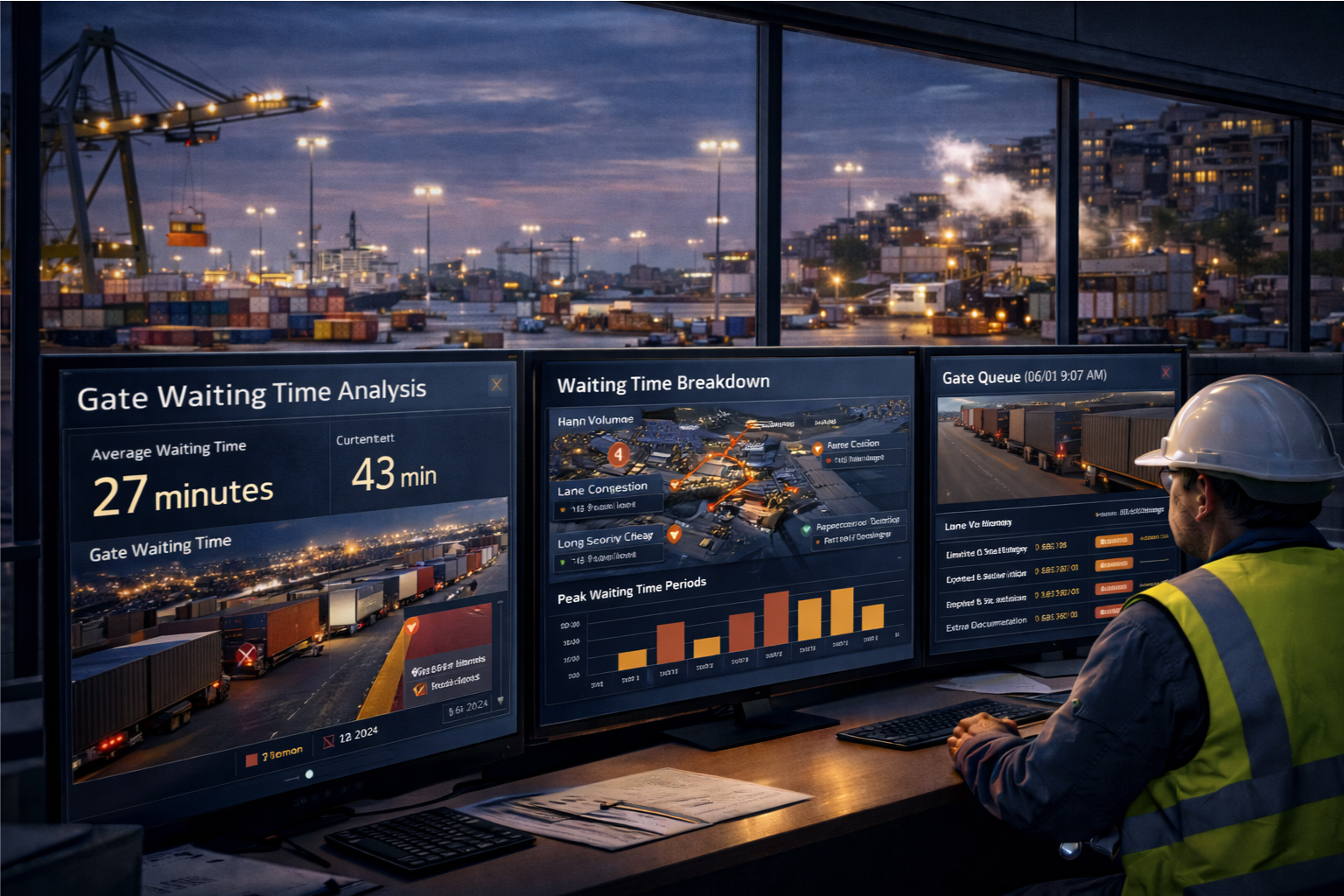
Gate Waiting Time Analysis
Scenario | Peak Hours for Container Truck Entry
During certain periods, container trucks queuing outside the gate can affect overall operational rhythm.
Traditional Situation
– Queue duration is difficult to quantify
– Congestion causes are often inferred from experience
After Implementation
– The system analyzes the time required for vehicles from entry to completion of gate processing
– Management units can identify time periods with significantly increased waiting times
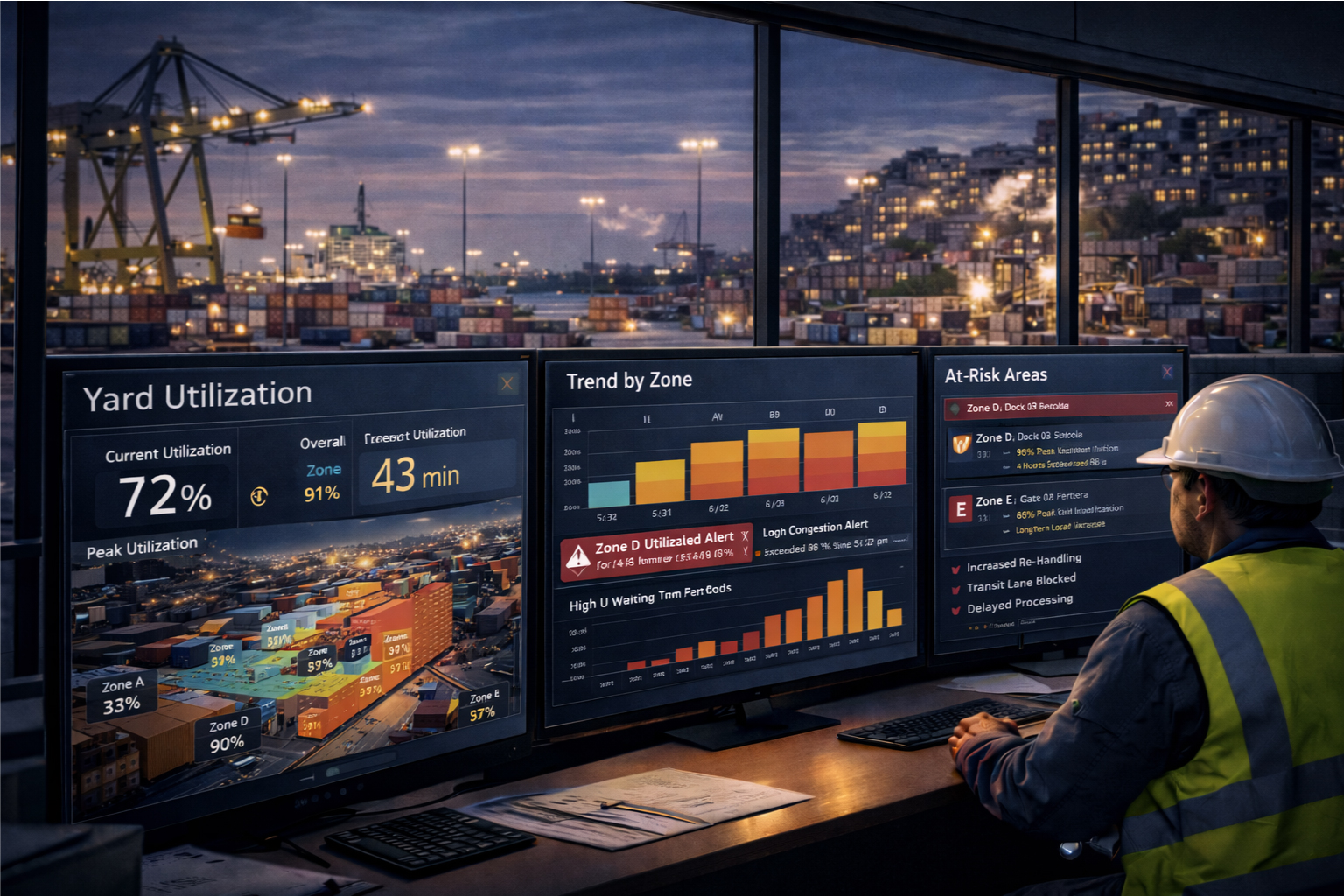
Yard Utilization Observation
Scenario | Yard Space Allocation and Dispatching
Yard space utilization directly affects container handling efficiency and re-handling risk.
Traditional Situation
– Utilization is often judged based on personnel experience
– Certain areas may become overly congested
After Implementation
– The system visualizes utilization changes across yard areas
– Management units can identify areas under prolonged high load
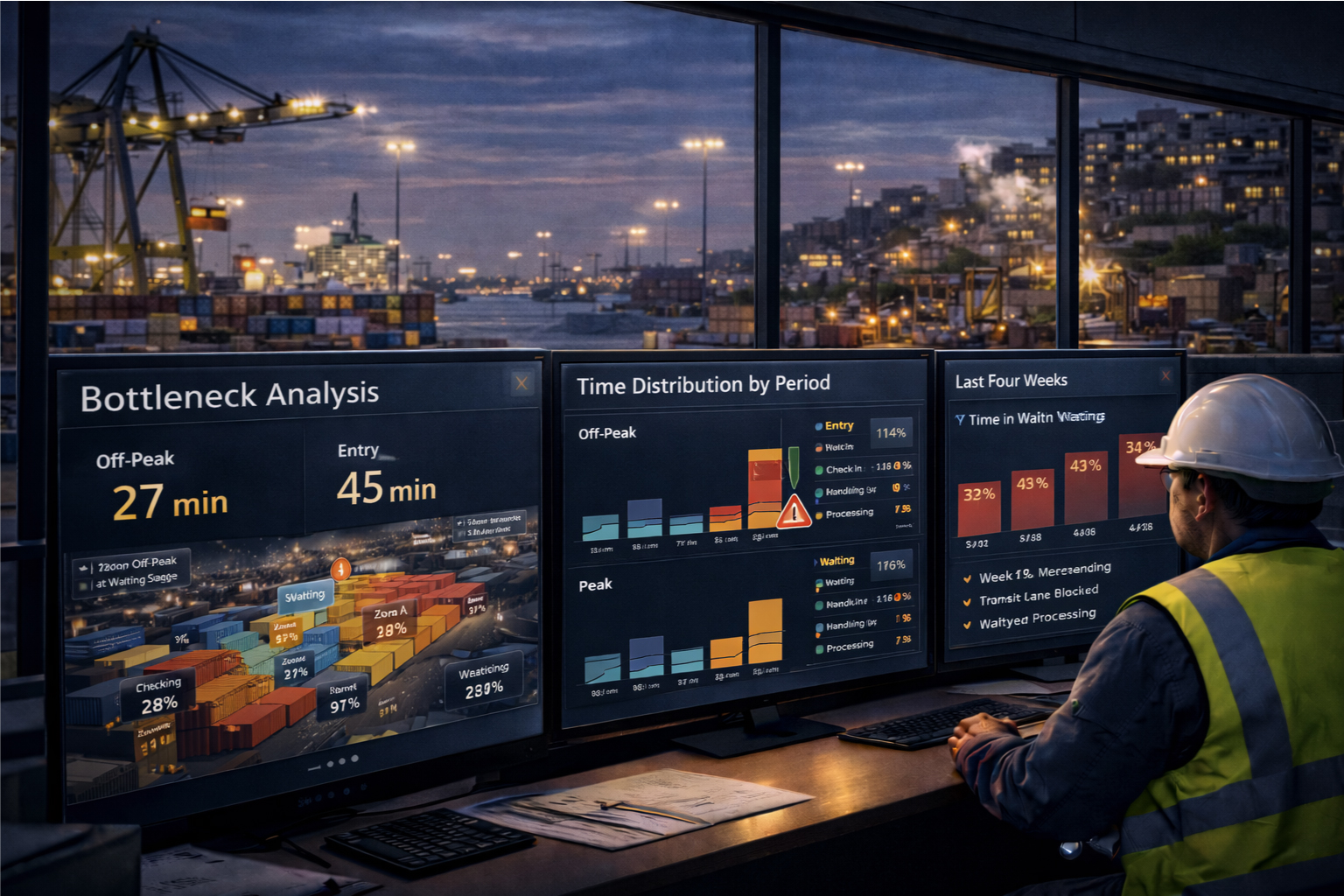
Peak and Off-Peak Process Bottleneck Analysis
Scenario | Daily Operational Rhythm Variations
Operational performance often differs significantly between peak and off-peak periods.
After Implementation
– The system compares time consumption across process nodes during different periods
– Management units can determine whether bottlenecks consistently occur at specific stages
Yard Placement Strategy Module
Positioning Description
This module is positioned to support management units by providing clear and explainable reference recommendations prior to yard placement decisions. Its purpose is not to replace on-site dispatch judgment, but to transform existing experience and historical data into visual information, reducing the likelihood of re-handling, congestion, and repetitive operations.
❖ Management Value
– Reduces costs associated with re-handling and repeated dispatching
– Helps new personnel quickly acquire yard management experience
– Transforms experience into sustainable management assets
– Does not affect existing dispatch authority or operational workflows
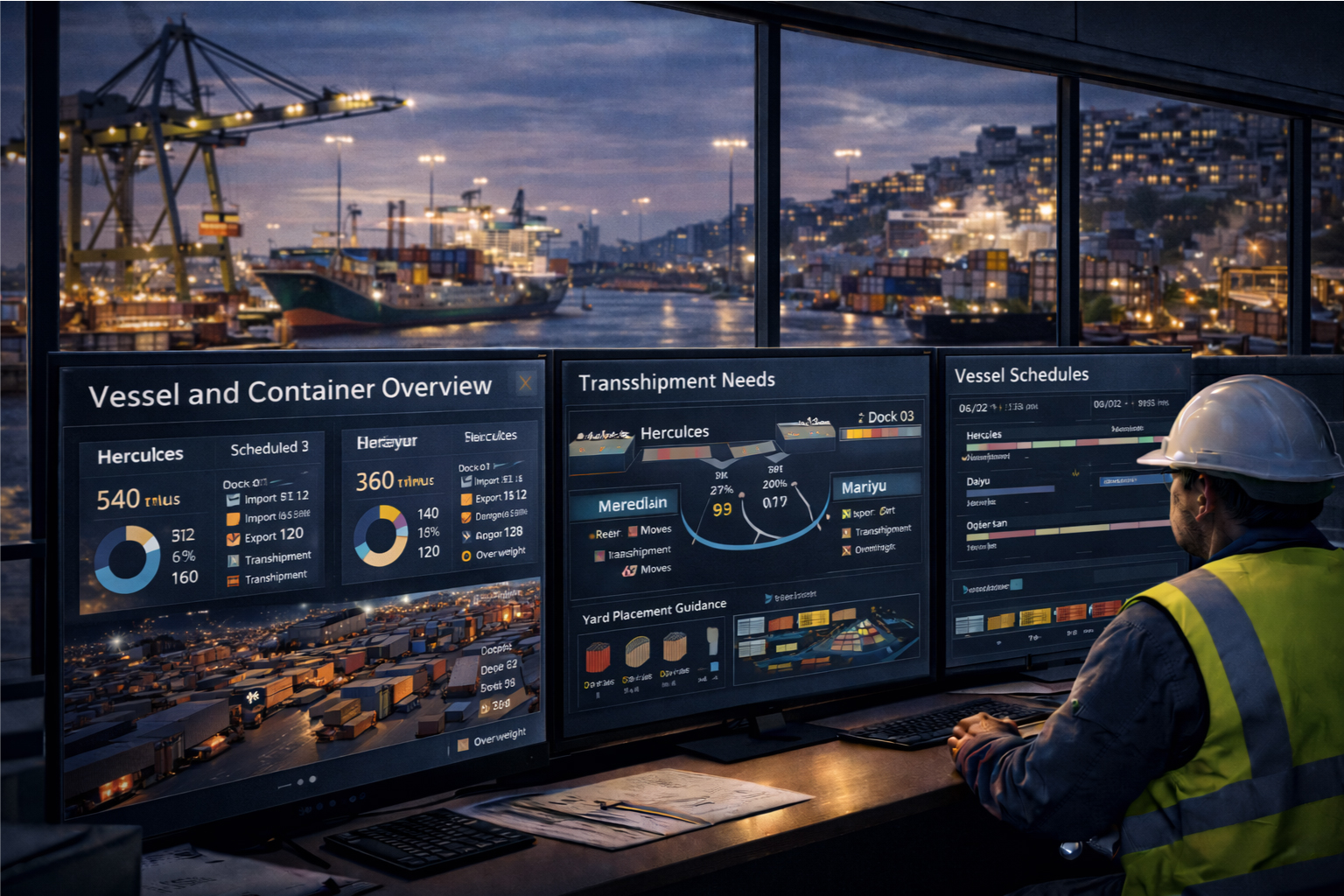
Analysis of Vessel Schedules, Container Types, and Transshipment Needs
Scenario | Multiple Vessels Berthing Concurrently
When multiple vessels berth within a short period, involving transshipment containers, import containers, and various container types, yard placement complexity increases significantly.
After Implementation
– The system consolidates vessel schedules, container characteristics, and transshipment requirements
– Provides reference guidance for yard placement decisions
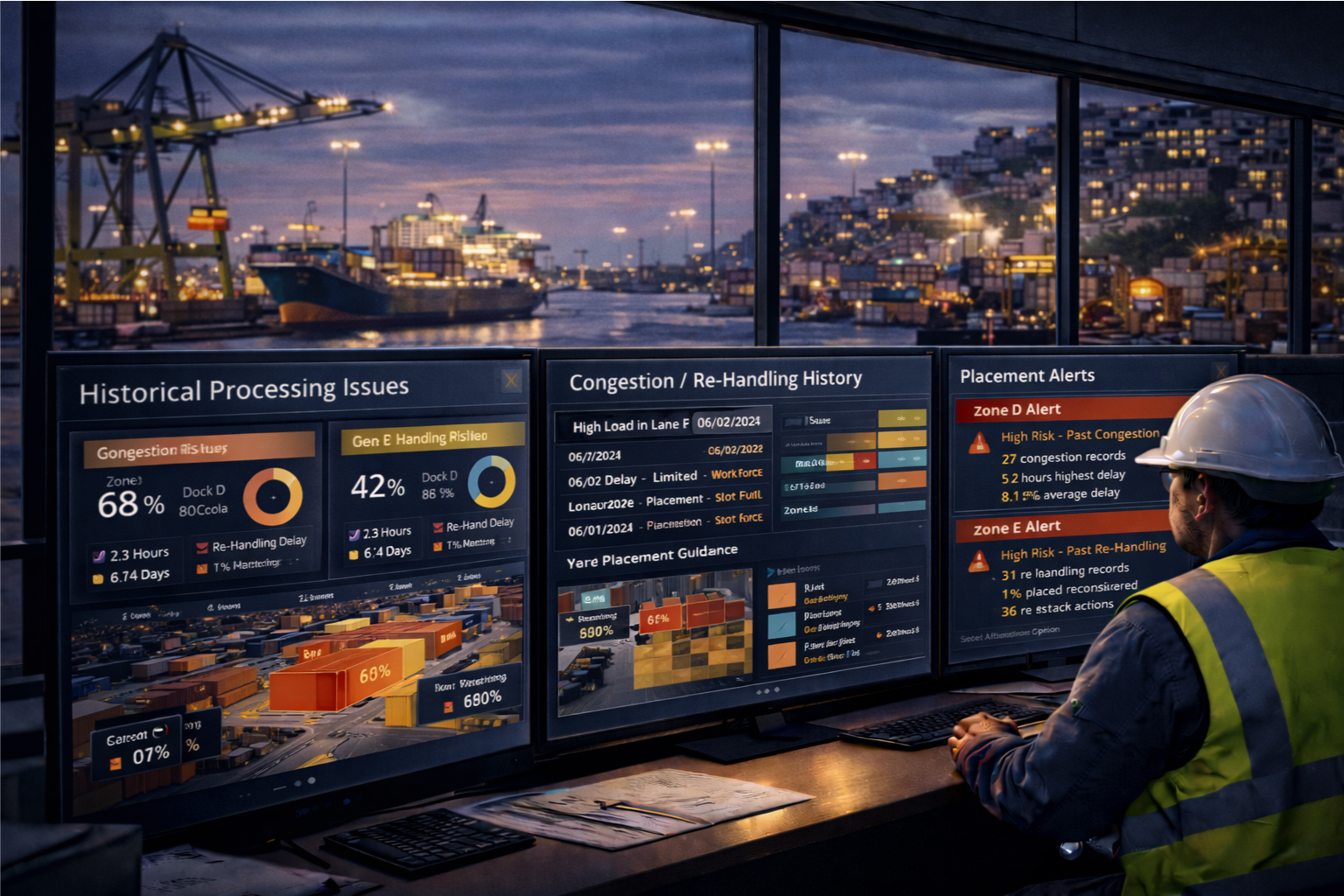
Reference to Historical Congestion and Re-Handling Records
Scenario | Preventing Recurrent Operational Issues
Certain yard areas have historically experienced frequent congestion or re-handling. Without systematic records, experience is difficult to accumulate.
After Implementation
– The system references historical event data
– Alerts management units to placement options with higher historical risk
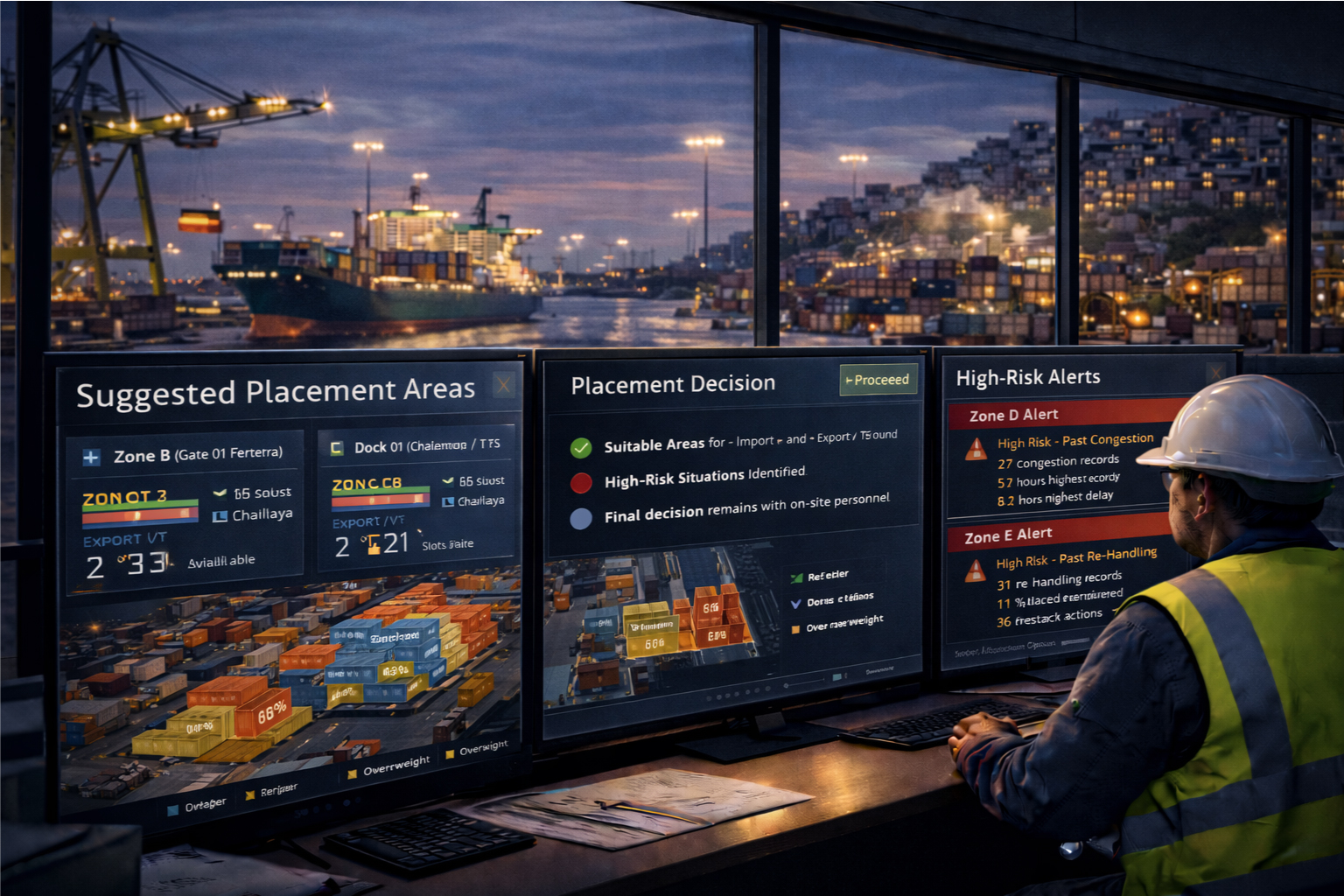
Suggested Placement Areas and High-Risk Alerts
Scenario | Final Check Before Dispatch Decision
Before executing yard placement, management units and dispatchers need to rapidly assess potential risks.
After Implementation
– The system suggests suitable placement areas
– Simultaneously highlights high-risk scenarios that may cause congestion or re-handling
– Final decisions remain with on-site personne
AI × AR Assisted Maintenance Knowledge Module
Positioning Description
This module is positioned to help maintenance personnel more quickly understand equipment conditions and repair procedures, while transforming scattered individual or paper-based maintenance experience into accumulative knowledge assets. Its purpose is not to replace expert technicians’ judgment, but to reduce experience gaps and improve consistency and safety in maintenance operations.
❖ Management Value
– Reduces maintenance risks caused by experience disparities
– Shortens equipment downtime
– Improves operational safety and consistency
– Converts technical know-how into long-term organizational assets
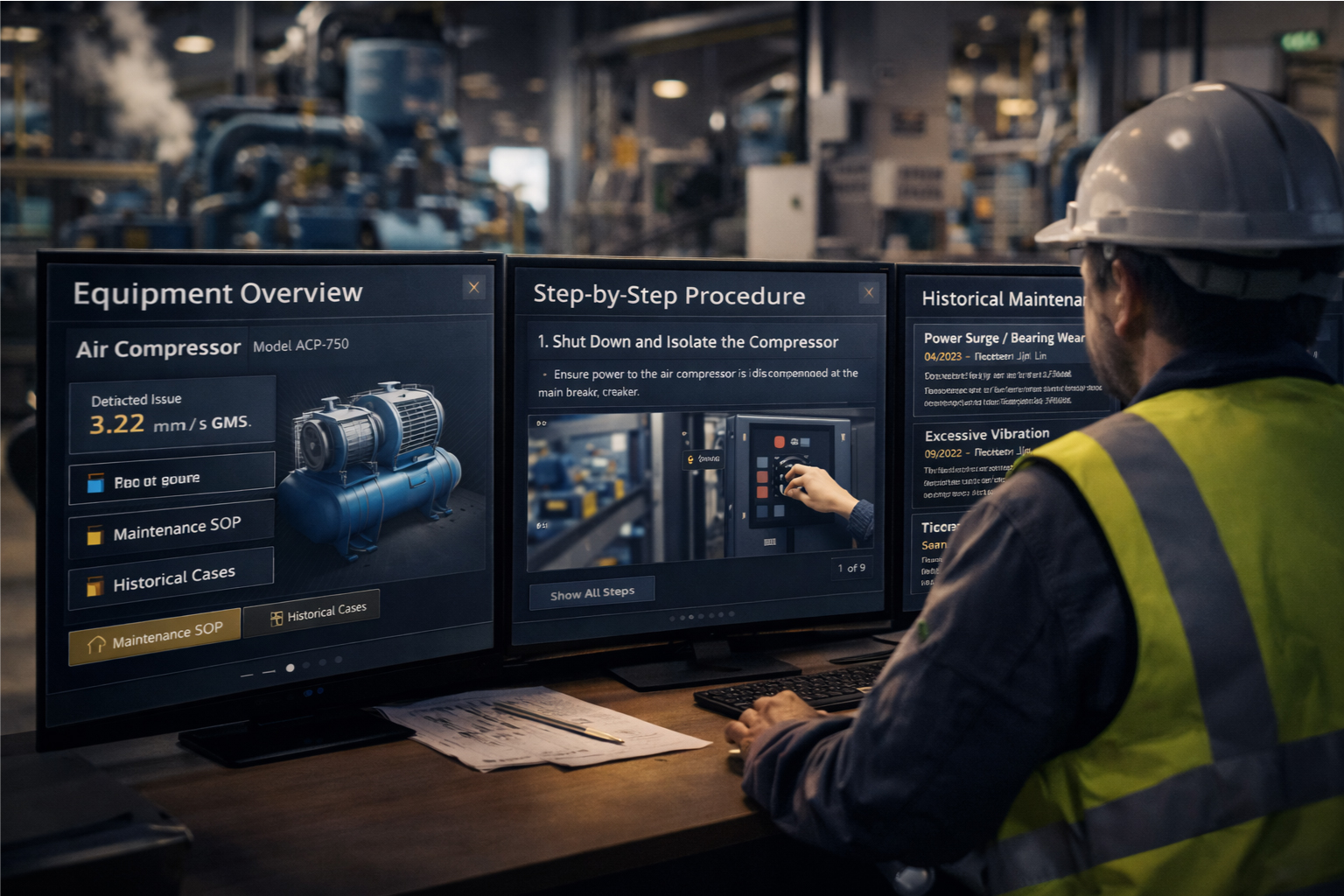
Integration of Equipment Manuals, SOPs, and Historical Cases
Scenario | Equipment Requires Inspection Due to Abnormality
When equipment malfunctions occur, maintenance personnel often need to consult multiple documents or seek advice from experienced colleagues.
After Implementation
– The system integrates equipment manuals, standard operating procedures, and historical maintenance cases
– Maintenance personnel can quickly access relevant information
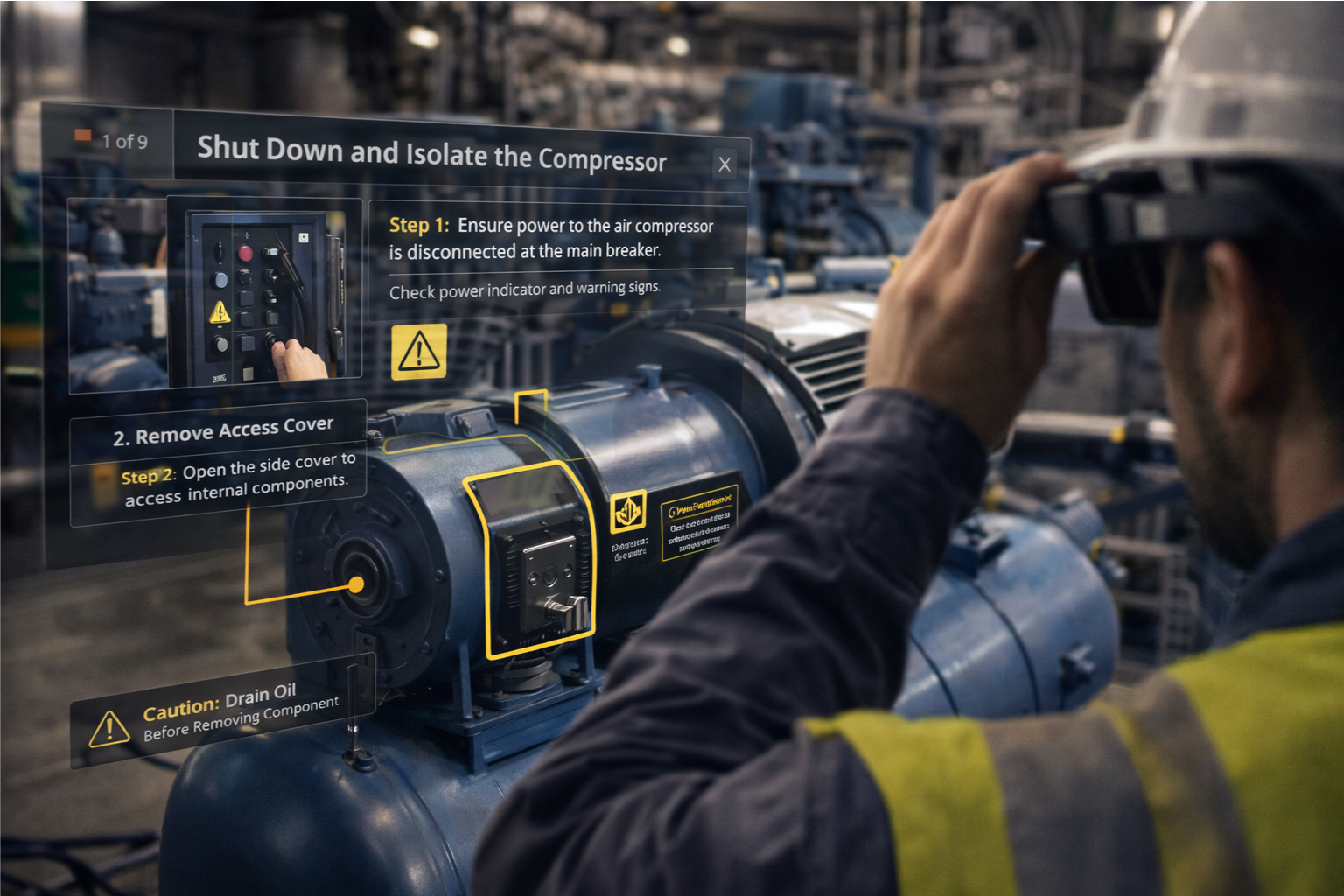
AR-Based Maintenance Guidance
Scenario | On-Site Maintenance in Progress
During on-site maintenance, personnel must operate equipment while confirming procedures, which may lead to omissions due to complex environments.
After Implementation
– Through AR devices or mobile equipment
– Maintenance steps and precautions are visually overlaid
– Assists personnel in completing tasks step by step
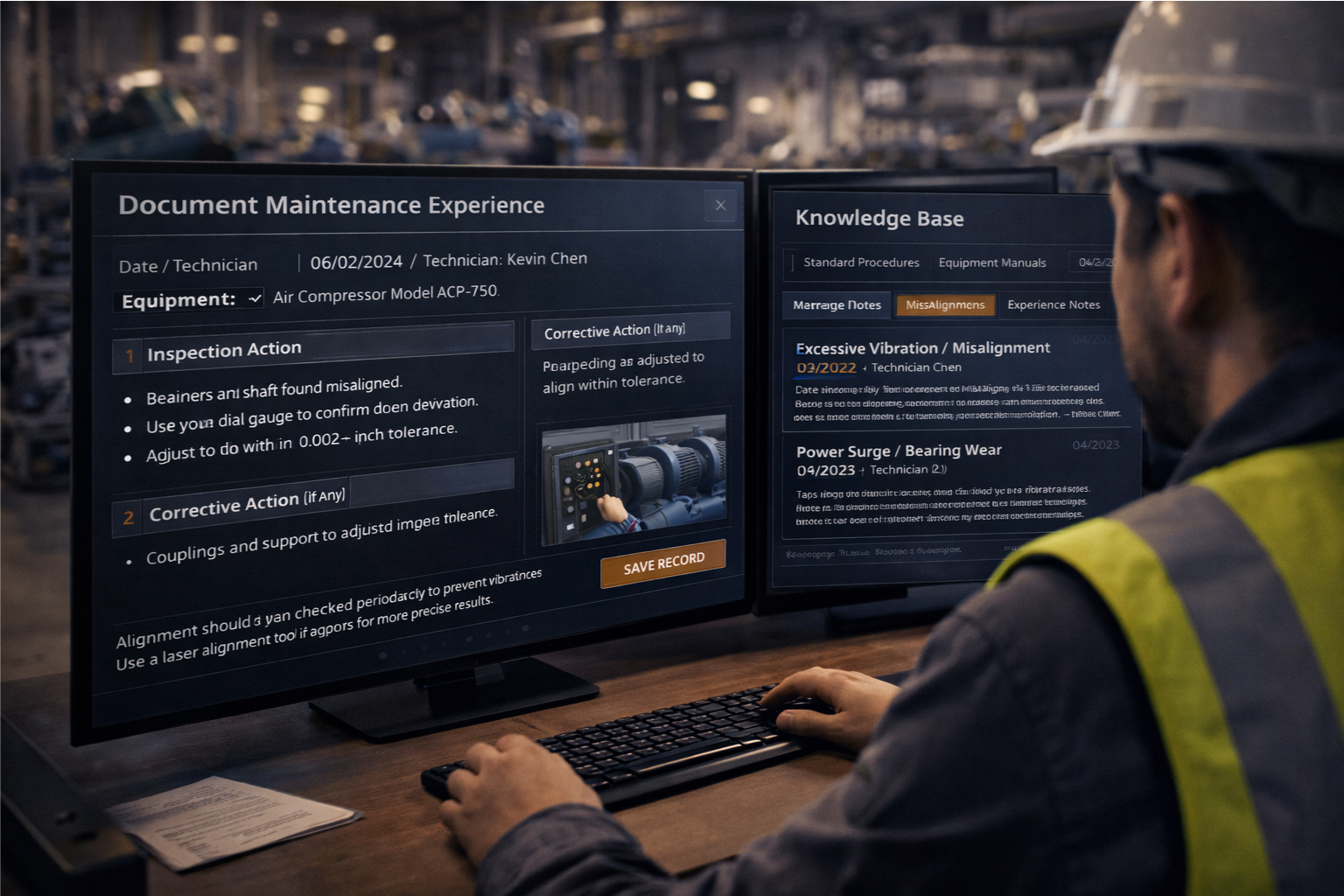
Feeding Maintenance Experience Back into Knowledge Base
Scenario | After Maintenance Completion
Much practical experience remains in individuals’ memory and is difficult to pass on.
After Implementation
– Maintenance records and practical experience can be fed back into the system
-Gradually forms a searchable knowledge base
Management Decision Support and Long-Term Trend Analysis Module
Positioning Description
This module is positioned to transform daily operational event data into analytical perspectives for mid- to long-term decision-making. Its purpose is not to command on-site operations in real time, but to assist government and port executives in understanding operational trends from the perspectives of risk, efficiency, and cost, providing a basis for investment, expansion, and policy planning.
❖ Management Value
– Supports policy and investment decisions with factual data
– Reduces risks associated with subjective judgment
– Enhances persuasiveness in external communication and cross-department coordination
– Does not intervene in real-time operations or on-site command
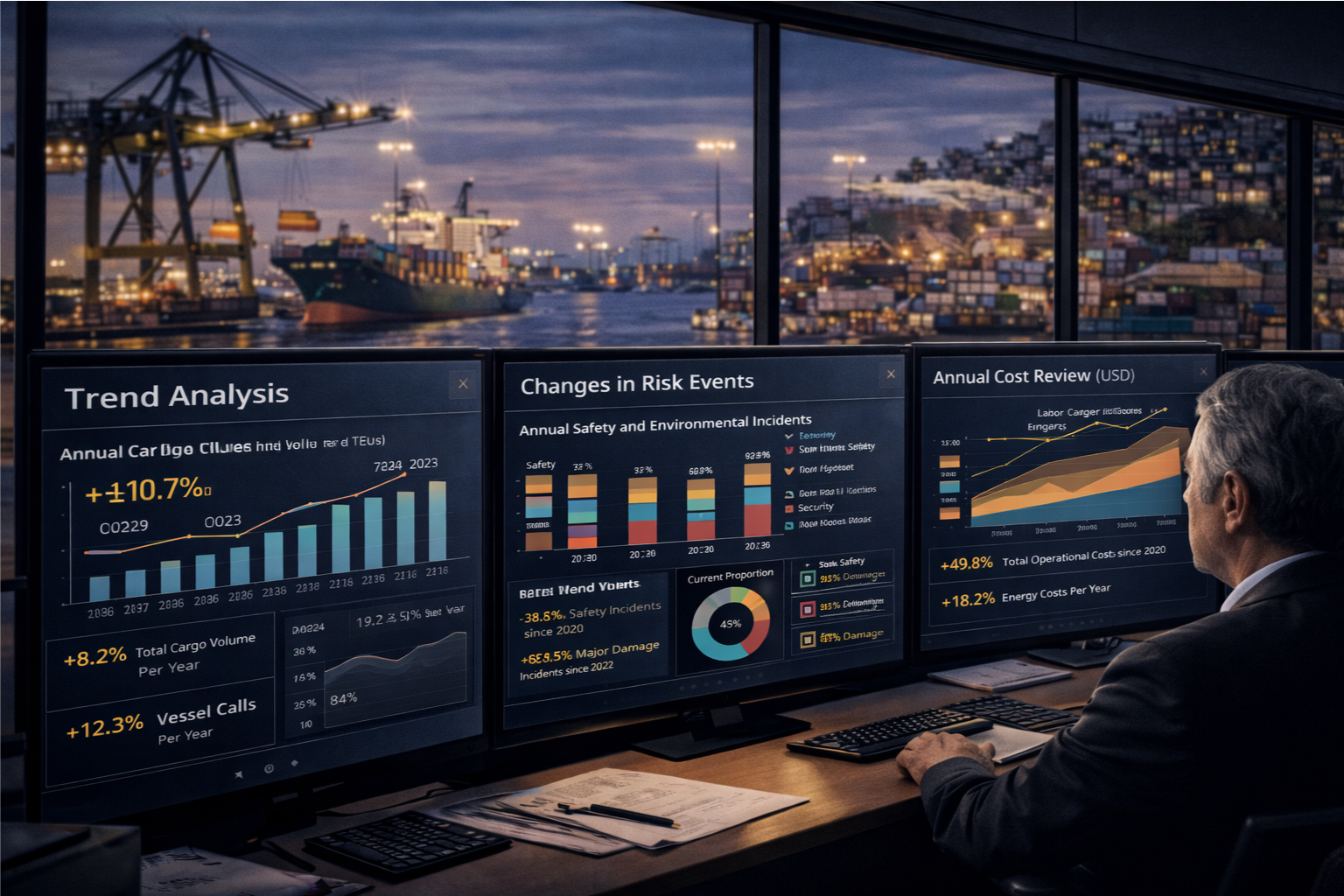
Trend Analysis
Scenario | Annual and Multi-Year Operational Review
Over long-term operations, ports accumulate large volumes of operational, equipment, environmental, and safety-related events.
After Implementation
– The system visualizes:
– Trends in operational volume
– Changes in risk event frequency
– Helps management understand overall port development direction
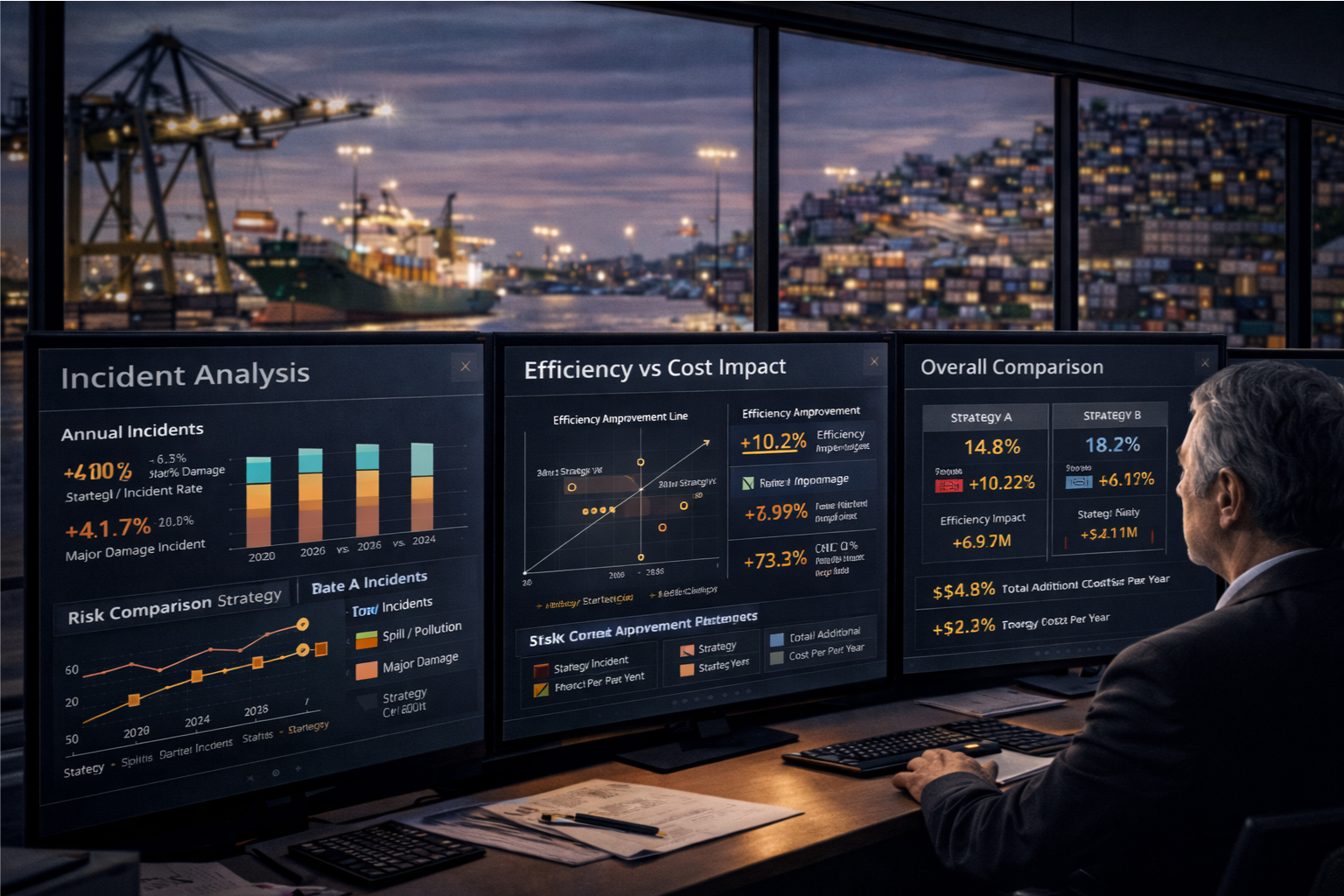
Integrated View of Risk × Efficiency × Cost
Scenario | Executive Evaluation of Management Strategy Adjustments
Single indicators often fail to reflect real operational conditions; executives require multi-dimensional insights.
After Implementation
– Integrates risk events, operational efficiency, and cost-related data
– Supports comparison of impacts from different management strategies
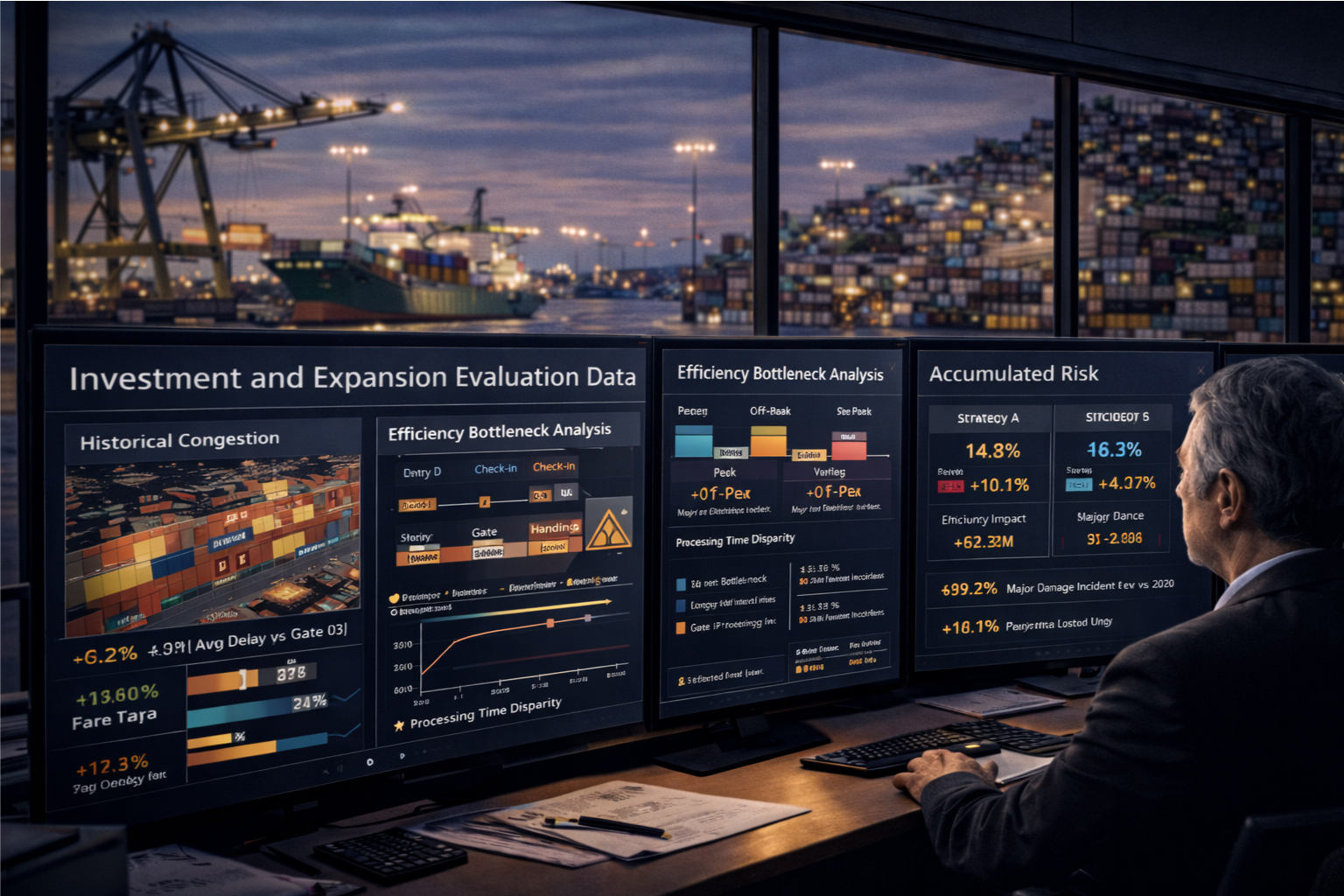
Investment and Expansion Evaluation Data
Scenario | Evaluating Expansion of Gates, Yards, or Equipment
When governments and port authorities consider expansion decisions, they require concrete and explainable data foundations.
After Implementation
– Provides historical congestion, efficiency bottleneck, and accumulated risk data
-Serves as supporting evidence for expansion or equipment investment
AIOT Data Integration & Event Platform (Core Foundation)
Positioning Description
This module serves as the backbone of the entire system, ensuring that all data is properly integrated, non-duplicated, and never lost.
❖ Management Value
– Eliminates data silos
– Ensures flexibility for future system expansion
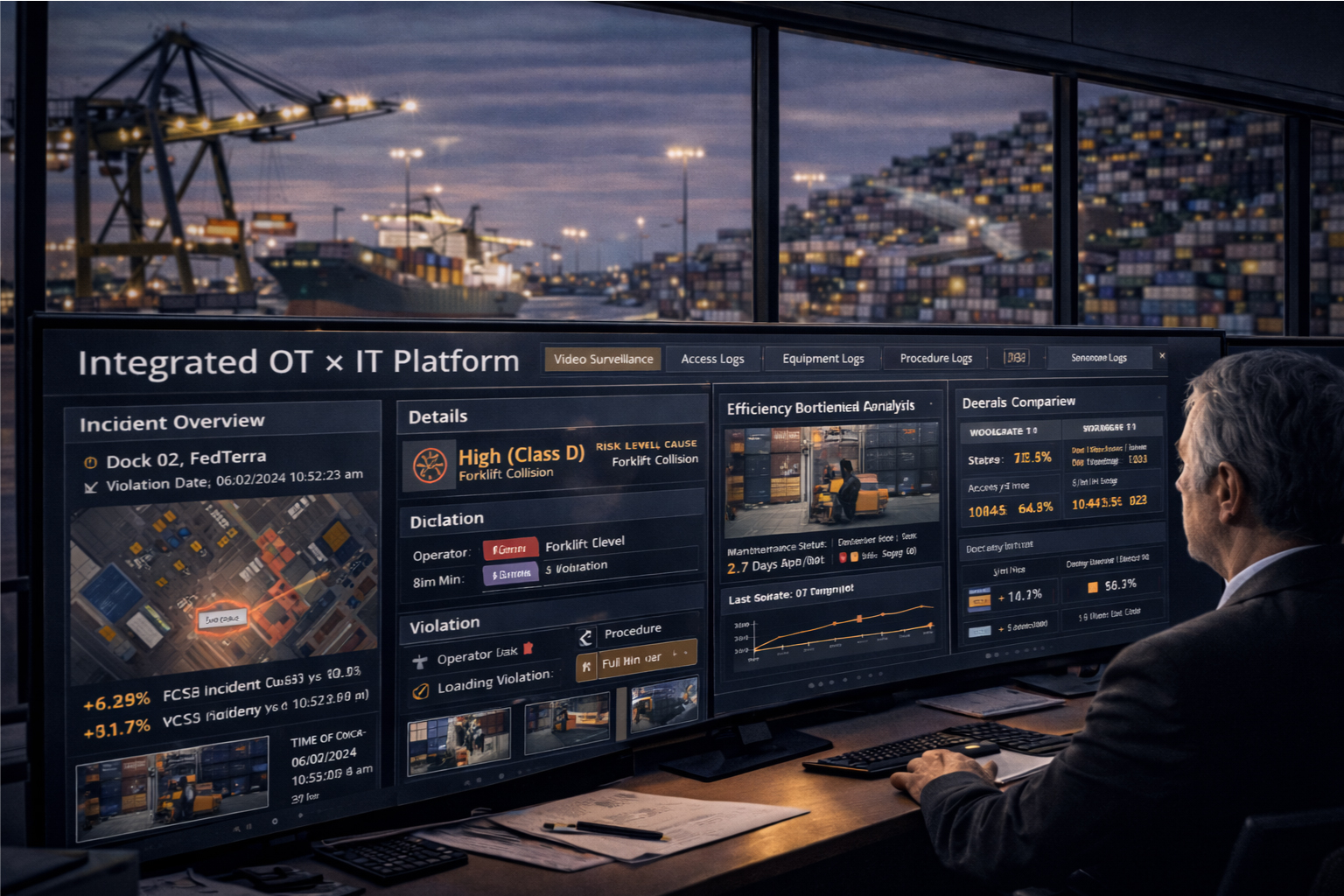
OT × IT System Integration
Scenario | After an incident, authorities request a complete explanation
Actual Situation
When an incident occurs in the port area, authorities typically ask:
– Where did the incident occur?
– What were the equipment conditions at that time?
– Were personnel operating according to procedures?
Traditional Situation
– Video footage stored in surveillance systems
– Entry and exit records stored in gate systems
– Equipment status stored in maintenance systems
→ Data is scattered, and consolidation may take several days
After Implementation
– On-site operational technology (OT) data and management IT systems are integrated
– Managers can view, on a single interface:
- Operational records at the time of the incident
- Equipment status
– Related images and event records
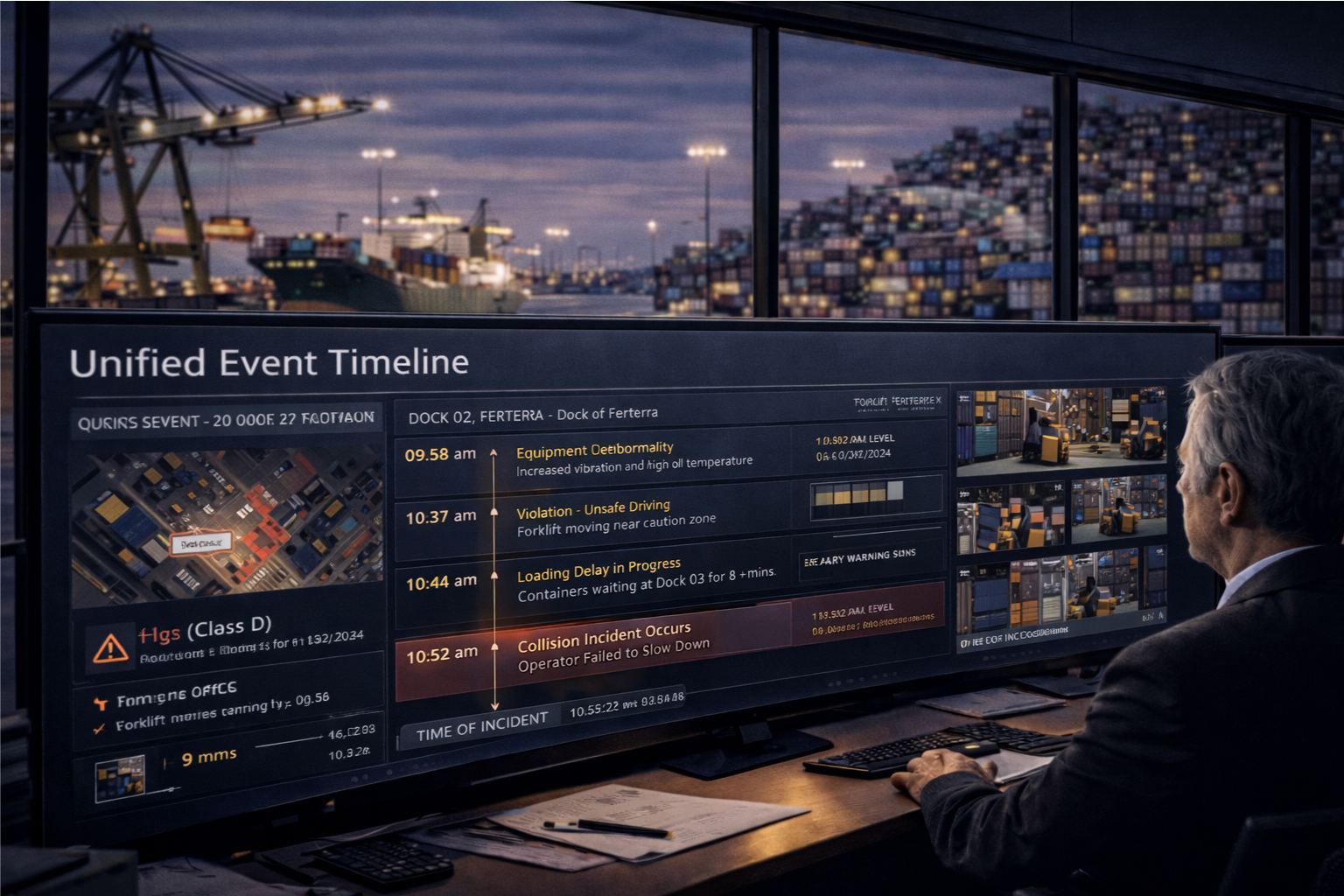
Unified Event Timeline
Scenario | Clarifying how events unfolded step by step
Actual Situation
Management needs to determine:
– Whether the incident occurred suddenly or had early warning signs
– What abnormalities occurred before and after the incident
Traditional Situation
– Each system maintains its own timestamp
– Time records are not synchronized
– Difficult to reconstruct a complete sequence of events
After Implementation
– All events are arranged in chronological order, including:
- Equipment anomalies
- People–vehicle interaction risks
- Operational delays
– Managers can clearly understand:
→ “What happened first, and what followed
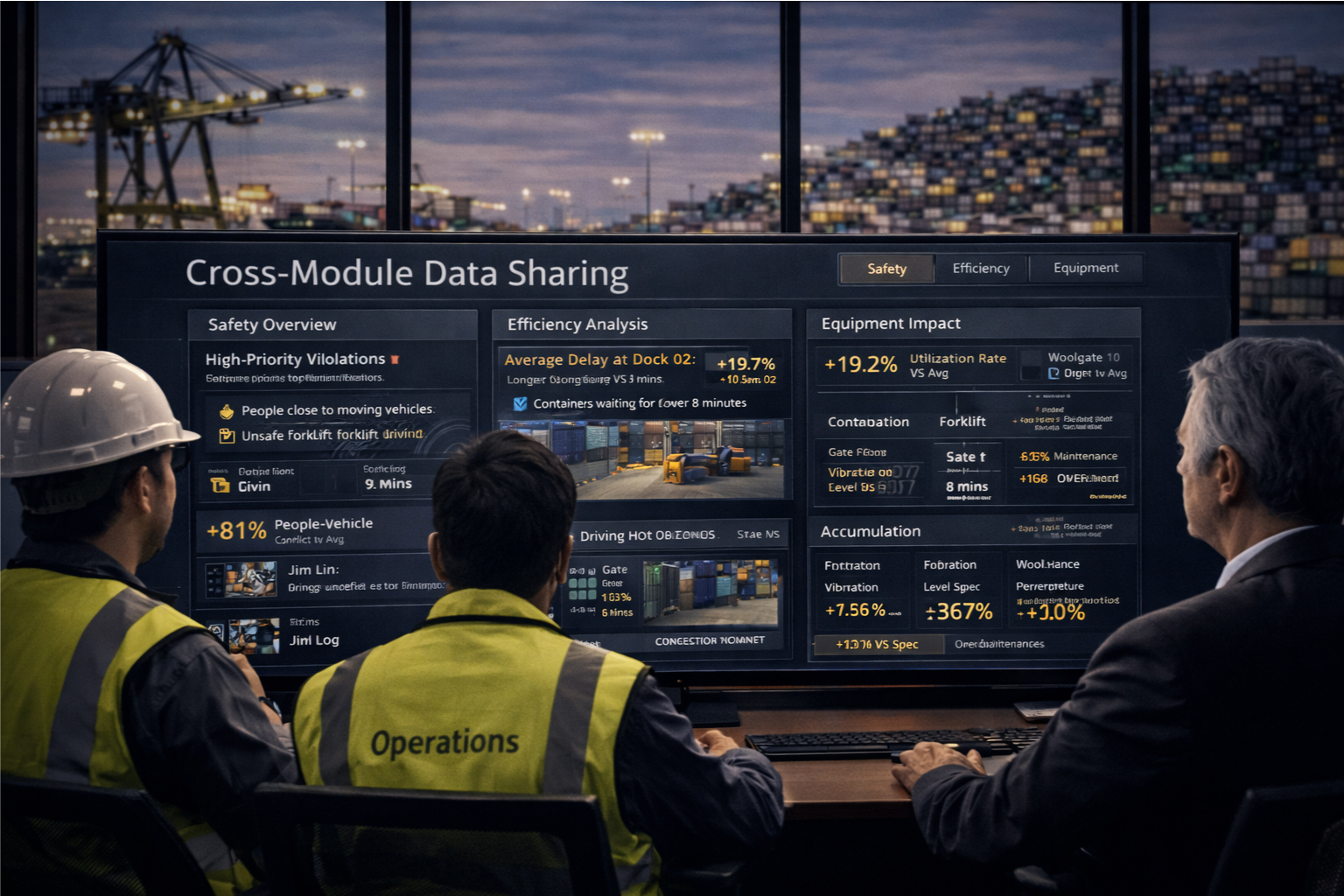
Cross-Module Data Sharing
Scenario | Multiple departments addressing the same issue
Actual Situation
Recurring issues in a specific area:
– Safety teams report people–vehicle conflicts
– Operations teams report low efficiency
– Equipment teams report overused machinery
Traditional Situation
– Each department reviews its own data
– Discussions become fragmented and unclear
After Implementation
– The same event data is shared across:
- Safety modules
- Efficiency analysis modules
- Risk hotspot analysis modules
-All departments discuss based on a single, consistent source of truth
Cybersecurity, Access Control & System Resilience Module
Positioning Description
Ensures the system complies with government requirements for security and operational stability.
❖ Management Value
– Meets government cybersecurity requirements
– Ensures long-term stable port operations
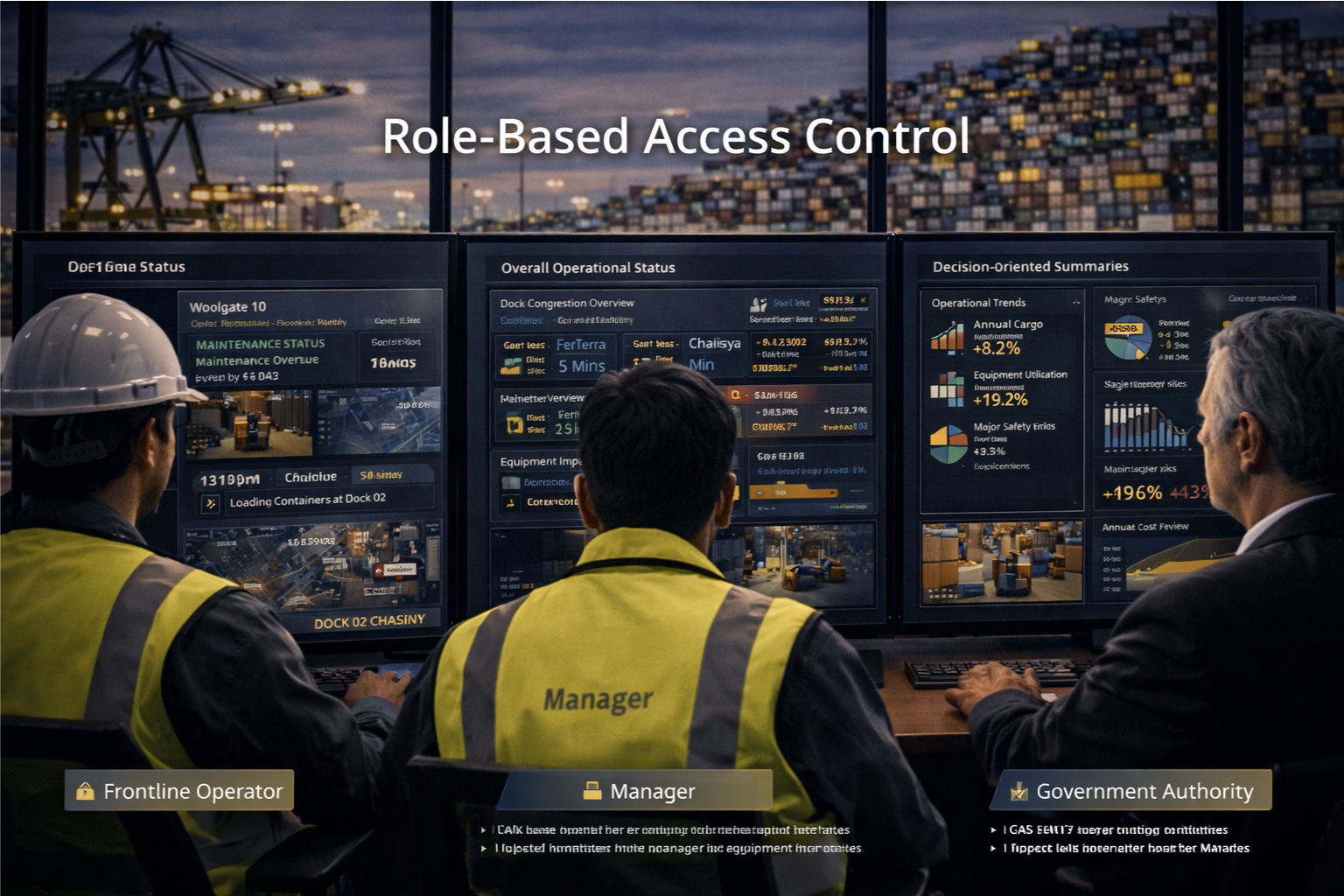
User and Role-Based Access Control
– Frontline operators access only their relevant operational data
– Managers view overall operational status and aggregated information
– Government authorities view decision-oriented summaries
– Clear visibility boundaries correspond to clear responsibilities
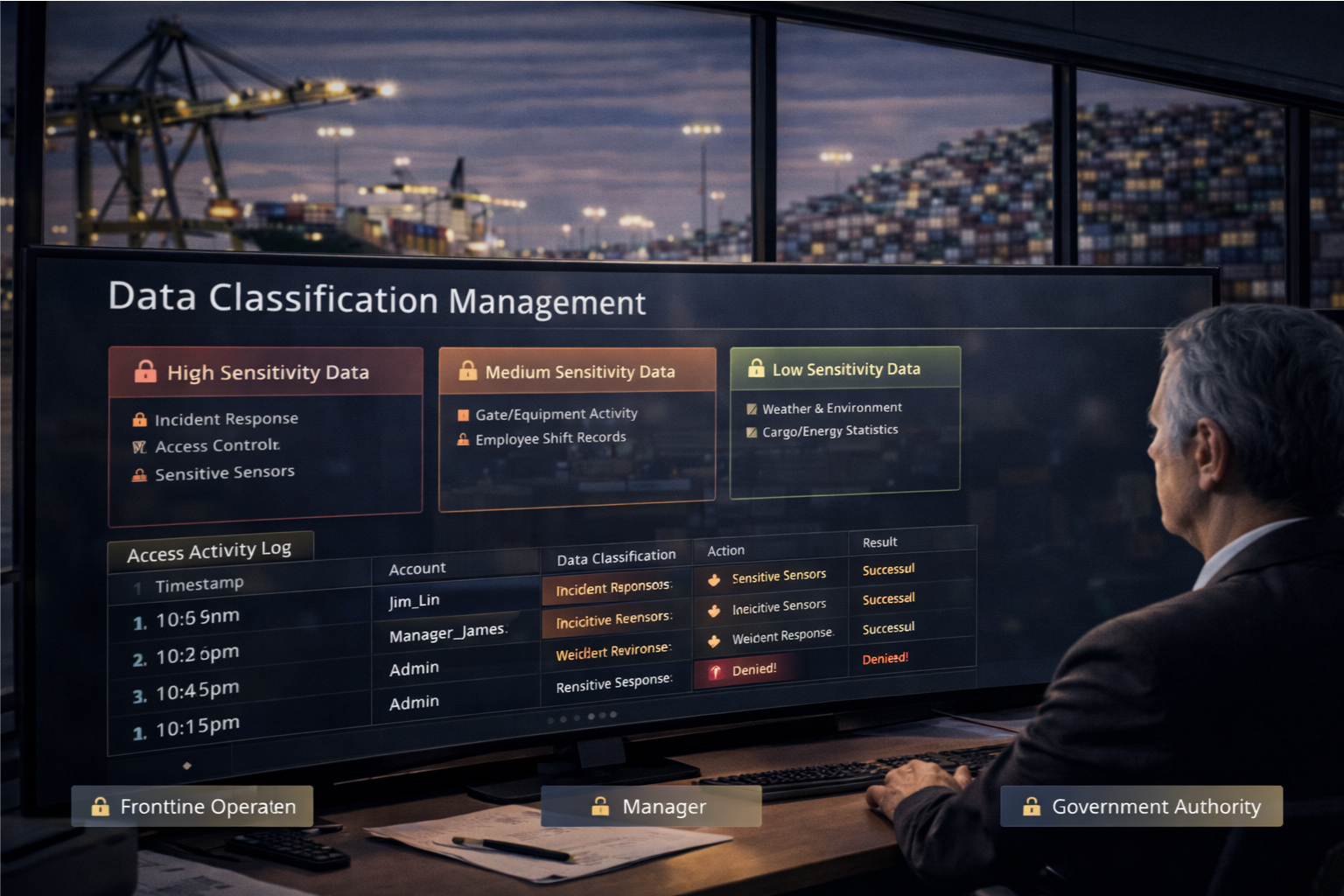
Data Classification Management
– Data is classified based on sensitivity levels
– All data access and retrieval activities are logged for auditing
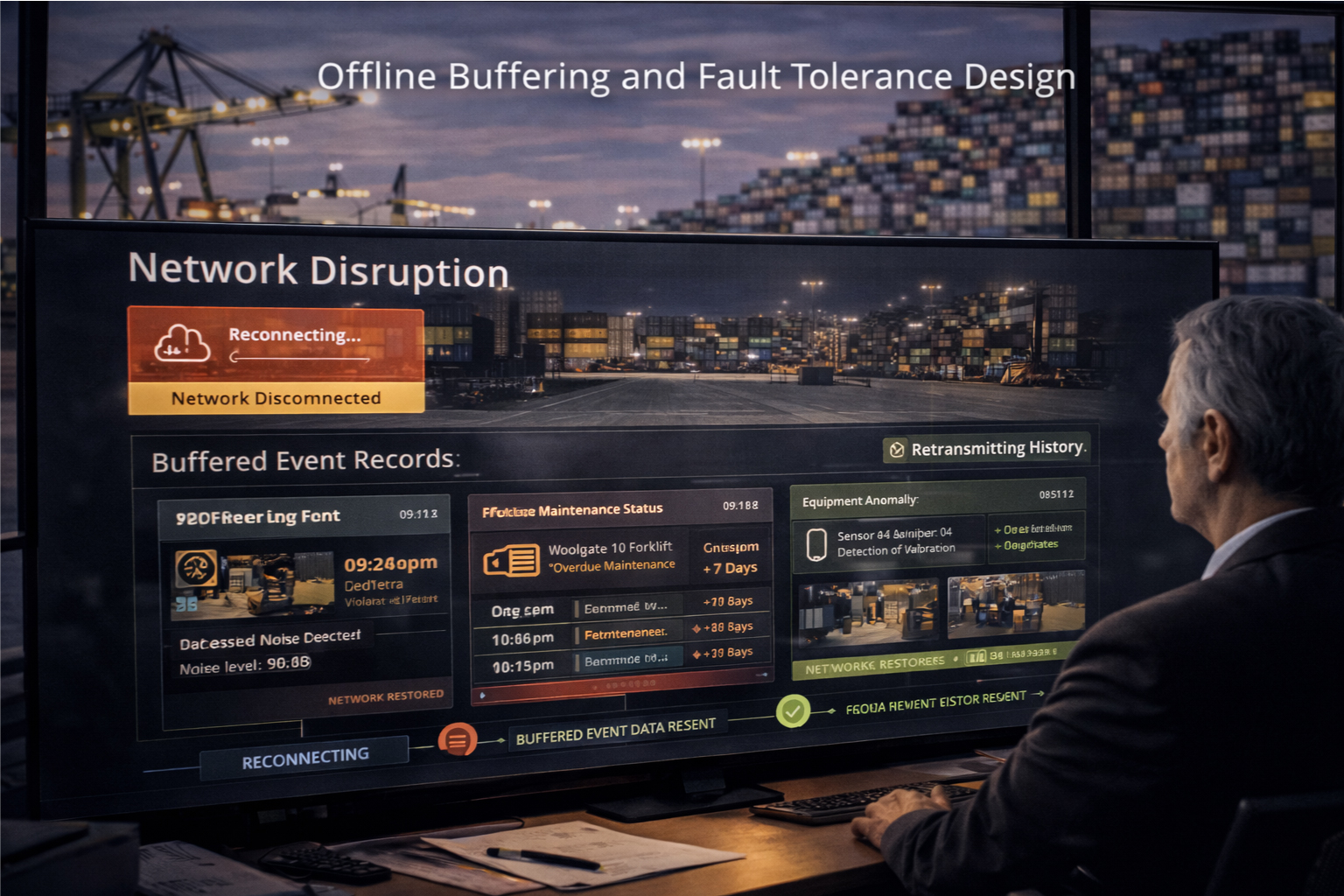
Offline Buffering and Fault Tolerance Design
– Data is temporarily cached during network disruptions
– Automatically retransmitted once connectivity is restored
– Ensures complete and uninterrupted event records